Reservoir simulation

Known as Arena, the collaboration aims to improve decision-making across increasingly complex reservoirs and growing volumes of subsurface data.
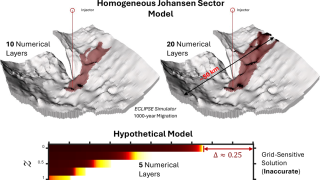
A new framework combines analytical and numerical insights, extending vertical equilibrium modeling and guiding reservoir-scale implementation, providing reservoir engineers with practical guidance for assessing accuracy across flow regimes and long-term carbon-dioxide migration.

This article from the SPE Integrated Reservoir Management Technical Section (IRMTS) examines the closed-loop IRM approach, from insight to execution to learning, and the limits of technology-driven solutions.
-
 Although the wellbore is in a nonisothermal environment, heat transfer between the fluid in the wellbore and the formation is often ignored and temperature is usually assumed constant in data interpretation, which will lead to misunderstanding of the pressure profile.
 -
A matured field is currently producing with greater than 85% water cut (WC) and has significant levels of uncertainty with respect to oil/water contact (OWC), flank structure, depth of spill points, production allocation, and residual oil saturation.
-
For engineering design teams, the market downturn is an opportunity to review practices and learn from others who have used hard times to reshape processes through simulation while cutting development time and costs.
-
Conventional miscible- or near-miscible-gasflood simulation often overestimates oil recovery, mostly because it does not capture a series of physical effects tending to limit interphase compositional exchanges.
-
To understand production from shale reservoirs, the role of hydraulically induced fractures, natural fractures, and their interaction in a formation must be captured.
-
An 18-well numerical-simulation model was built to represent an operator’s Lower Shaunavon waterflood-pilot area. Numerical simulation was used, and a history match on the pilot area was performed.
-
To optimize the development plan of a giant carbonate reservoir offshore Abu Dhabi to extend the production plateau and improve recovery, detailed sector models were used to facilitate the large number of required simulation runs.
-
The process of drilling a borehole is very complex, involving surface and downhole drilling systems that interact with the drilling fluid and the surrounding rocks.
-
This paper proposes a framework based on proxies and rejection sampling (filtering) to perform multiple history-matching runs with a manageable number of reservoir simulations.
-
This article reviews methods used to understand the complexities associated with production from shale.