Reservoir simulation

This paper presents a high-fidelity, reservoir-centric stimulation-to-production modeling workflow to prevent fracture-driven interactions.

This work elaborates on recommended practices for calibrating a numerical model to a set of available infill-well field observations.

Known as Arena, the collaboration aims to improve decision-making across increasingly complex reservoirs and growing volumes of subsurface data.
-
 Machine-learning methods have gained tremendous attention in the last decade. The underlying idea behind machine learning is that computers can identify patterns and learn from data with minimal human intervention. This is not very different from the notion of automatic history matching.
-
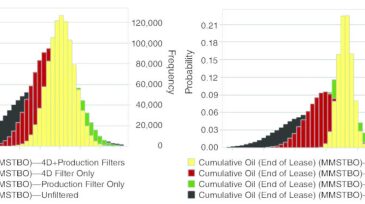
This paper outlines the value of 4D for reducing uncertainty in the range of history-matched models and improving the production forecast.
-
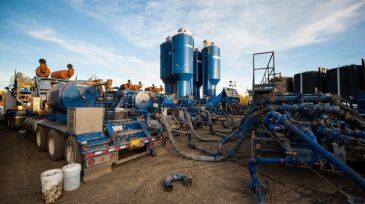
The struggle to overcome the challenge of frac hits has led to a critical dialogue about which pathway the shale sector should take. One idea is to simply put the problem at the center of every major decision.
-
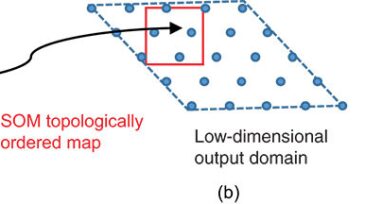
A new geostatistics modeling methodology that connects geostatistics and machine-learning methodologies, uses nonlinear topological mapping to reduce the original high-dimensional data space, and uses unsupervised-learning algorithms to bypass problems with supervised-learning algorithms.
-
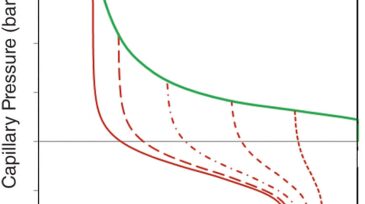
This paper presents a saturation-modeling approach for fields and reservoirs with complex hydrocarbon-charging histories. The model resolves saturation-height functions for the primary-drainage, imbibition, and secondary-drainage equilibriums.
-
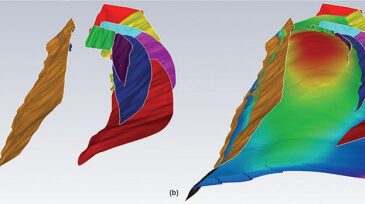
This paper proposes a novel work flow for structural-features modeling that allows the introduction of faults and other structural and nonstructural features to any simulation grid without modification.
-
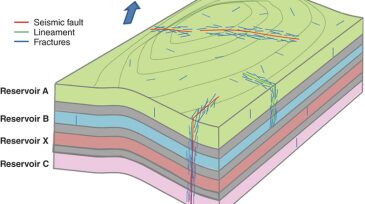
Natural fractures can have a significant effect on fluid flow by creating permeability anisotropy in hydrocarbon reservoirs.
-
A radical digital revolution is happening all around us (or so we are told). Applying this to reservoir simulation, we apparently need to understand better when and, more importantly, when not to use such technology—to appreciate its bounds, its limitations, its range of validity, and so on.
-
SponsoredA Midland Basin case study on estimating production, drainage volume, and interference from multiple stacked wells.