Reservoir simulation

This article from the SPE Integrated Reservoir Management Technical Section (IRMTS) examines the closed-loop IRM approach, from insight to execution to learning, and the limits of technology-driven solutions.

This paper presents a case study from a mature field redevelopment project where pulsed neutron logging was integrated with advanced reservoir modeling to improve the understanding of fluid-contact dynamics and optimize new horizontal well placement.

This paper aims to showcase examples of how integrated analysis of surveillance data in the Azeri-Chirag-Gunashli field has improved reservoir understanding and informed reservoir-management decisions.
-
 The authors of this paper review the advantages of machine learning in complex compositional reservoir simulations to determine fluid properties such as critical temperature and saturation pressure.
 -
This work presents an integrated multiphase flow model for downhole pressure predictions that produces relatively more-accurate downhole pressure predictions under wide flowing conditions while maintaining a simple form.
-
This paper details how the reservoir modeling workflow can be accelerated, and uncertainty reduced, even for challenging greenfield prospects by constructing multiple small fit-for-purpose integrated adaptive models.
-
The integration of artificial intelligence/machine learning with traditional workflows marks a turning point, unleashing the immense potential of these proven techniques to address our everyday challenges in reservoir simulation.
-
The honor recognizes recipients for their lasting and significant contributions in the field of IOR.
-
Definition and call for participation in the 11th Society of Petroleum Engineers Comparative Solution Project, which is motivated by the immense challenge of achieving geological carbon storage at a scale that impacts significantly atmospheric emission of carbon dioxide.
-
The index integrates three independent components extracted from static and dynamic parameters: reservoir permeability thickness, movable gas, and reservoir pressure from a historically matched dynamic model.
-
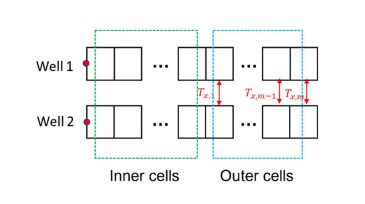
The authors of this paper propose a hybrid approach that combines physics with data-driven approaches for efficient and accurate forecasting of the performance of unconventional wells under codevelopment.
-
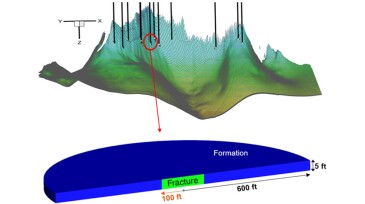
This paper describes a full-field and near-wellbore poromechanics coupling scheme used to model productivity-index degradation against time.
-
This paper develops a deep-learning work flow that can predict the changes in carbon dioxide mineralization over time and space in saline aquifers, offering a more-efficient approach compared with traditional physics-based simulations.