Reservoir

Industry experts at URTeC assessed more than a decade of unconventional growth while discussing where productivity gains will come from next.
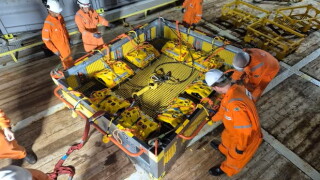
The technology has passed its first phase of qualification, with 84 nodes placed on the seafloor at a depth of 2,000 m to acquire 4D seismic data in the pre-salt Santos Basin.

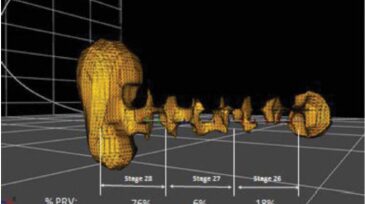
Chevron and Halliburton describe how they built and deployed the fully autonomous closed-loop fracturing system that enables subsurface-driven optimization.
-
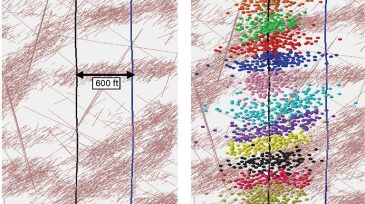
 The objective of this study is to validate the concept of using a seismically derived discrete fracture network (DFN) calibrated with borehole measurements, for complex-hydraulic-fracture modeling.
 -
SPE conferences in Calgary examine the challenges of finding and producing heavy oil and unconventional hydrocarbons at a time when Canadian producers are feeling exceptional price pressures.
-
With an uncertain future spawning from the Brexit referendum, the British government is seeking to maintain as much consistency in its energy policy as possible.
-
A new play in the Permian Basin is unconventional in an unexpected way: there is a small group of independents producing from a watery formation where oil production begins after they have pumped only water for weeks.
-
Knowledge of the maximum- and minimum-permeability directions in anisotropic reservoirs helps to optimize injector and producer locations and is important for reservoir management, especially under secondary or enhanced recovery of hydrocarbons.
-
The application of high-precision downhole temperature sensors has resulted in pressure-transient analysis (PTA) being complemented or replaced by temperature-transient analysis (TTA).
-
This paper describes the method developed to achieve underbalanced drillstem testing (DST) in a deepwater field offshore India.
-
Carbo Ceramics is making big strides in the use of ceramic proppant.
-
Current conditions have made most companies decide to optimize performance of their existing assets, and EOR is a key part of that.
-
A critical step in proper design and optimization of any chemical-enhanced-oil-recovery (CEOR) process is appropriate and precise numerical simulations.