Reservoir

Industry experts at URTeC assessed more than a decade of unconventional growth while discussing where productivity gains will come from next.
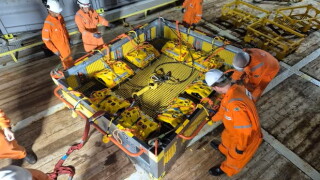
The technology has passed its first phase of qualification, with 84 nodes placed on the seafloor at a depth of 2,000 m to acquire 4D seismic data in the pre-salt Santos Basin.

Chevron and Halliburton describe how they built and deployed the fully autonomous closed-loop fracturing system that enables subsurface-driven optimization.
-
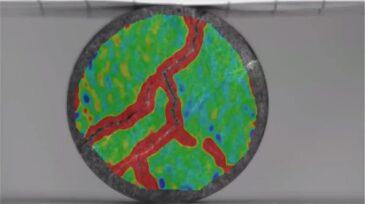
 Technology that allows researchers to see stress forming inside rock samples may help unravel some of the mysteries associated with fracture behavior.
 -
Getting a good well for a field test can make or break a new idea. A government backed research group in Saskatchewan is offering up to CAD 100,000 break on royalty payments to test ways to extend the life of conventional, heavy-oil fields.
-
Advancement of the integration of seismic with other oilfield disciplines has been fueled by two factors. First, advances in seismic technologies naturally led to more-powerful integration. Second, developments in seismic were motivated in direct response to the needs of interpreters and engineers.
-
Cost optimization in heavy-oil production can be achieved through numerical modeling to suggest general optimal strategies and development plans or by using proper real-time data acquisition … for prompt decisions while operations are ongoing.
-
The authors used a high-quality digital-log data set to characterize reservoir quality accurately in the Niobrara and Codell Formations in the Denver-Julesberg (DJ) Basin.
-
The A East Haradh formation contains a 200-m-thick oil column of highly viscous oil, with viscosity ranging from 200 to 400,000 cp.
-
The most popular technology for producing heavy oil (HO) and bitumen is reservoir heating, mainly by steam injection.
-
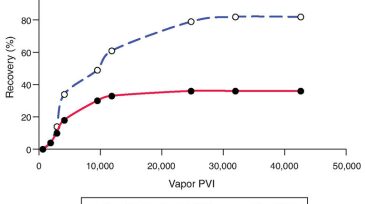
This paper presents an investigation into the effect of catalytic nanoparticles on the efficiency of recovery from continuous steam injection.
-
Three-dimensional reservoir models are best created with a combination of well logs and 3D-seismic data. However, the effective integration of these results is not easy because of limited seismic resolution.
-
The paper discusses an approach for predicting the lateral variation of net to gross (NTG) by use of 3D probabilistic seismic inversion.