Reservoir

Industry experts at URTeC assessed more than a decade of unconventional growth while discussing where productivity gains will come from next.
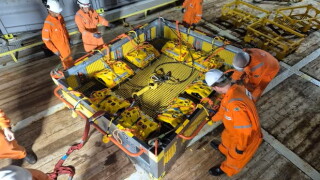
The technology has passed its first phase of qualification, with 84 nodes placed on the seafloor at a depth of 2,000 m to acquire 4D seismic data in the pre-salt Santos Basin.

Chevron and Halliburton describe how they built and deployed the fully autonomous closed-loop fracturing system that enables subsurface-driven optimization.
-
 The all-stock transaction is expected to bolster the newly created operator's production profile to around 160,000 BOE/D.
 -
Finding creative ways to drive down the CAPEX and discounted OPEX and define a realistic pathway and schedule to full-scale commercial operations is discussed.
-
Oil isn’t going away, but that misses the fact that a demand plateau will structurally change the industry for people and companies in the most geologically mature areas, especially the United States.
-
Operator will use polymerized water into reservoir to boost oil and gas recovery.
-
The paper evaluates the effect of different injection methods on oil recovery and CO2 storage potential in a depleted sandstone reservoir in the Norwegian Continental Shelf.
-
Our industry has been the custodian of subterranean reservoirs. We are the experts in managing and developing them. Why not use that expertise to find solutions for climate change by capturing and removing carbon and being part of the solution?
-
Case studies demonstrate how an autonomous outflow-control device prevents growth and excessive fluid injection into thief/fracture zones and maintains a balanced or prescribed injection distribution.
-
This paper presents recent results from a rigorous pilot-scale demonstration of natural-gas foam over a range of operating scenarios relevant to surface and bottomhole conditions with a variety of base-fluid mixtures.
-
The complete paper reviews the history of enhanced oil recovery and the Scurry Area Canyon Reef Operators Committee, discusses changes in theory over time, and provides a look at the field’s future.
-
The authors demonstrate how reservoir management and operational strategies can be used to optimize CO2 storage and oil recovery.