Reservoir

Industry experts at URTeC assessed more than a decade of unconventional growth while discussing where productivity gains will come from next.
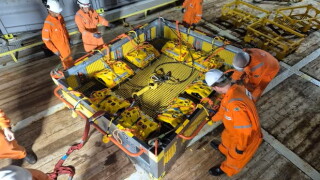
The technology has passed its first phase of qualification, with 84 nodes placed on the seafloor at a depth of 2,000 m to acquire 4D seismic data in the pre-salt Santos Basin.

Chevron and Halliburton describe how they built and deployed the fully autonomous closed-loop fracturing system that enables subsurface-driven optimization.
-
 An appropriate work flow of combining suitable advanced technologies can help to overcome the long-standing challenges of sub-basalt imaging.
 -
The interpretation of well tests, combined with petrophysical analysis, formation-test data, and production logs, provided insight into Khuff reservoirs.
-
Most of today’s equipment and interpretation methods are indeed not new. After all, well testing has been around for nearly a century, resulting in a legacy that may not always look cutting-edge, but these tried-and-true tools were so technologically remarkable that they became staples.
-
The paper outlines examples from tight gas reservoirs in two fields in which openhole data was unavailable and petrophysical analysis was undertaken using cased-hole data.
-
The papers explore innovative approaches developed by authors of SPE conference papers toward avoiding data bias, working around the absence of openhole data, and reducing the uncertainty of mass-transport complexes.
-
The work and the provided methodology provide a significant improvement in facies classification.
-
Interface Fluidics carved out a niche for itself in the oilfield testing sector a few years ago with a new alternative to coreflooding. Now, along with Equinor, the Calgary-based company is taking on another industry laboratory stalwart: the slimtube test.
-
The authors introduce and compare two quality-control approaches based on two different signal-processing practices.
-
Innovators at the Norwegian oil company have developed a machine-learning model that analyzes mud-gas data to predict the gas/oil ratio of wells as they are drilled—something that the industry has worked for decades to accomplish.
-
As I reviewed all the SPE seismic papers this time, the most noticeable thing was the diversity of themes and case histories that were covered.