Reservoir

Industry experts at URTeC assessed more than a decade of unconventional growth while discussing where productivity gains will come from next.
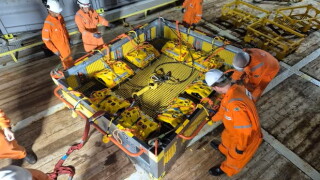
The technology has passed its first phase of qualification, with 84 nodes placed on the seafloor at a depth of 2,000 m to acquire 4D seismic data in the pre-salt Santos Basin.

Chevron and Halliburton describe how they built and deployed the fully autonomous closed-loop fracturing system that enables subsurface-driven optimization.
-
 Malaysia’s national oil and company will employ the technology suite in secondary recovery and well stimulation. The deal follows the service provider’s recent agreements in the Middle East.
 -
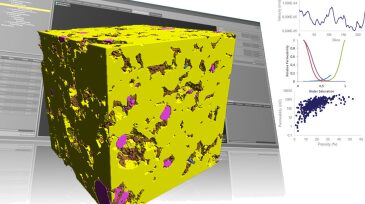
SponsoredThermo Scientific e-Core Software is a unique, high-performance computing platform for the characterization of complex porous media. It focuses on the three essential components of Digital Rock Analysis: parallel computing, multiscale modeling, and process-based reconstruction of 3D volumes.
-
The complete paper outlines some of the challenges involved in late-life field management and how Reserves assessment may be affected.
-
During the past decade, hundreds of unconventional oil and gas projects have failed to deliver the value sought by shareholders.
-
Even without the black swan event of COVID-19, the industry must critically examine the technical, commercial, and operational bases of the projects it proposes and executes. A logical, reasonable, ethical, and philosophical approach is critical to underpin good decision making and value creation.
-
In the complete paper, a philosophy for the future of EOR projects is developed through a series of questions that applies to the industry’s transition from completion of conventional EOR toward unconventional EOR.
-
The UK offshore Lancaster field was to prove that complex basement formations could be profitably developed. Instead, it is a reminder of how a long-term production test can drastically alter a reservoir model built upon years of exploration work.
-
The UAE produced 4 million B/D this year and is looking to these newly discovered resources to reach 5 million B/D by 2030.
-
To reach their targets for carbon neutrality, many oil and gas producers are investing in other energy industries. This US company will instead get there by investing more in its oil fields.
-
The first delivery of shale gas in the UAE marks a major milestone toward its goal of reaching 1 Bcf/D by 2030. It also signals the expansion of hydraulic fracturing in the UAE’s conventional fields.