Reservoir

Three papers are highlighted as the primary contributions because of their broad industry relevance. They focus on improving formation particle-size characterization, expanding the application of openhole gravel packs in depleted and compartmentalized reservoirs, and advancing the understanding of capillary pressure in sand production.

This paper aims to establish a set of best practices for generating particle-size-distribution data from core samples.

This paper discusses the successful execution of two openhole gravel-pack completions in two Gulf of Mexico fields with depleted reservoirs.
-
 The authors used a high-quality digital-log data set to characterize reservoir quality accurately in the Niobrara and Codell Formations in the Denver-Julesberg (DJ) Basin.
 -
The A East Haradh formation contains a 200-m-thick oil column of highly viscous oil, with viscosity ranging from 200 to 400,000 cp.
-
The most popular technology for producing heavy oil (HO) and bitumen is reservoir heating, mainly by steam injection.
-
This paper presents an investigation into the effect of catalytic nanoparticles on the efficiency of recovery from continuous steam injection.
-
Three-dimensional reservoir models are best created with a combination of well logs and 3D-seismic data. However, the effective integration of these results is not easy because of limited seismic resolution.
-
The paper discusses an approach for predicting the lateral variation of net to gross (NTG) by use of 3D probabilistic seismic inversion.
-
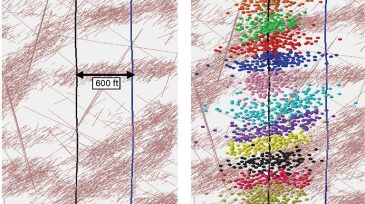
The objective of this study is to validate the concept of using a seismically derived discrete fracture network (DFN) calibrated with borehole measurements, for complex-hydraulic-fracture modeling.
-
SPE conferences in Calgary examine the challenges of finding and producing heavy oil and unconventional hydrocarbons at a time when Canadian producers are feeling exceptional price pressures.
-
With an uncertain future spawning from the Brexit referendum, the British government is seeking to maintain as much consistency in its energy policy as possible.
-
A new play in the Permian Basin is unconventional in an unexpected way: there is a small group of independents producing from a watery formation where oil production begins after they have pumped only water for weeks.