Reservoir

Three papers are highlighted as the primary contributions because of their broad industry relevance. They focus on improving formation particle-size characterization, expanding the application of openhole gravel packs in depleted and compartmentalized reservoirs, and advancing the understanding of capillary pressure in sand production.

This paper aims to establish a set of best practices for generating particle-size-distribution data from core samples.

This paper discusses the successful execution of two openhole gravel-pack completions in two Gulf of Mexico fields with depleted reservoirs.
-
 The implementation of chemical EOR has proven successful but the method faces significant technical and financial challenges.
 -
This paper presents a critical review of the recent literature to determine the status of research and development and field application of nanotechnology in the oil field.
-
This paper will describe how one integrates a comprehensive methodology of data-mining techniques and artificial neural networks (ANNs) in reservoir-petrophysical-properties prediction and regeneration.
-
Three major finds have shattered assumptions about what is possible in the most explored parts of Alaska’s North Slope.
-
A fast, integrated reservoir modeling tool used by Eni at Norway’s Goliat field generated an ensemble of models that helped confirm the location of previously identified infill drilling targets and identify several new infill locations.
-
We report a novel type of viscosity modifier relying on the supramolecular assemblies that have pH-adjustable viscosities and robust tolerance against high temperatures and salinities, and are resistant to shear-induced degradation.
-
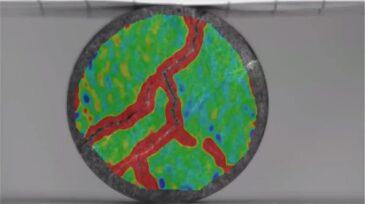
Technology that allows researchers to see stress forming inside rock samples may help unravel some of the mysteries associated with fracture behavior.
-
Getting a good well for a field test can make or break a new idea. A government backed research group in Saskatchewan is offering up to CAD 100,000 break on royalty payments to test ways to extend the life of conventional, heavy-oil fields.
-
Advancement of the integration of seismic with other oilfield disciplines has been fueled by two factors. First, advances in seismic technologies naturally led to more-powerful integration. Second, developments in seismic were motivated in direct response to the needs of interpreters and engineers.
-
Cost optimization in heavy-oil production can be achieved through numerical modeling to suggest general optimal strategies and development plans or by using proper real-time data acquisition … for prompt decisions while operations are ongoing.