Reservoir

Three papers are highlighted as the primary contributions because of their broad industry relevance. They focus on improving formation particle-size characterization, expanding the application of openhole gravel packs in depleted and compartmentalized reservoirs, and advancing the understanding of capillary pressure in sand production.

The solvent-based technology involves a modular treatment process that uses a proprietary catalyst designed to safely and sustainably remove hydrogen sulfide (H₂S) from sour gas streams using either produced water or an alkaline water as the treating media.

This paper aims to establish a set of best practices for generating particle-size-distribution data from core samples.
-
 The Norwegian data company has launched a 3D seismic survey in the Equatorial Margin area.
 -
This paper presents a unique investigation into determining the sufficient concentration of hardness ions required to significantly reduce the adsorption of acrylamide-tertiary-butyl-sulfonate-based polymer with a focus on mitigating polymer retention in carbonate formations using softened brine.
-
The deal comes only weeks after the private equity firm purchased a natural gas-fired plant operator.
-
India’s state oil company is accepting proposals from potential technical service partners until 15 September for EOR projects in the Arabian Sea.
-
The SPE IOR-EOR Terminology Review Committee has opened a period for public comments on a draft technical report.
-
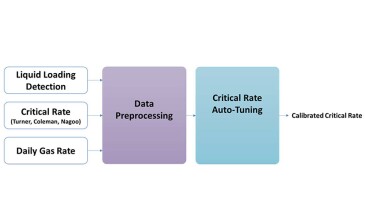
This paper describes a data-driven approach for liquid-loading detection and prediction that harnesses high-frequency gas-rate and tubinghead-pressure measurements to identify the onset of liquid loading and correct critical rates computed by empirical methods.
-
This paper outlines the importance of numerical rate transient analysis for dry gas wells, describing a simple, fully penetrating planar fracture model.
-
This study compares seven imputation techniques for predicting missing core-measured horizontal and vertical permeability and porosity data in two wells drilled in the North Rumaila oil field in southern Iraq.
-
This paper describes an approach that combines rock typing and machine-learning neural-network techniques to predict the permeability of heterogeneous carbonate formations accurately.
-
This study describes the performance of machine-learning models generated by the self-organizing-map technique to predict electrical rock properties in the Saman field in northern Colombia.