Reservoir

This paper aims to establish a set of best practices for generating particle-size-distribution data from core samples.

This paper discusses the successful execution of two openhole gravel-pack completions in two Gulf of Mexico fields with depleted reservoirs.

By integrating experimental and mathematical modeling approaches, this work aims to advance the understanding of sand-detachment dynamics and formation instability under varying saturation conditions.
-
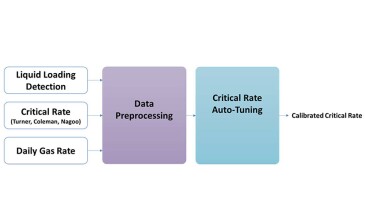
 This paper describes a data-driven approach for liquid-loading detection and prediction that harnesses high-frequency gas-rate and tubinghead-pressure measurements to identify the onset of liquid loading and correct critical rates computed by empirical methods.
 -
This paper describes an approach that combines rock typing and machine-learning neural-network techniques to predict the permeability of heterogeneous carbonate formations accurately.
-
This paper outlines the importance of numerical rate transient analysis for dry gas wells, describing a simple, fully penetrating planar fracture model.
-
High prices for untapped drilling locations in the Permian Basin have sparked some new trends in the tight oil dealmaking space.
-
Aramco’s investment pivot to gas aims to propel Saudi Arabia into the top tier of gas producers and LNG players globally by 2030.
-
The Integrated Reservoir Management Technical Section is committed to unite a community of technical professionals and academia driven to enhance reservoir performance by harnessing technological innovations and creating a collaborative space for strategic discussions and sustainable practices.
-
Fundamental research conducted to derive a transport model for ideal and partitioning tracers in porous media with two-phase flow that will allow fast and efficient characterization and selection of the correct tracer to be used in field applications.
-
The deal significantly expands the company’s position in the Bakken Shale play of North Dakota.
-
This paper highlights an approach of using active hydrogen to stimulate hard-to-recover formations from candidate-well selection through pilot execution and evaluation.
-
The authors of this paper review the advantages of machine learning in complex compositional reservoir simulations to determine fluid properties such as critical temperature and saturation pressure.