Reservoir

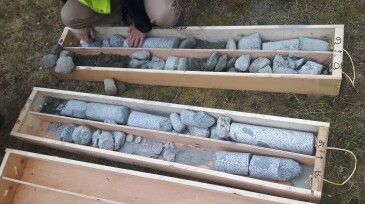
This paper aims to establish a set of best practices for generating particle-size-distribution data from core samples.

This paper discusses the successful execution of two openhole gravel-pack completions in two Gulf of Mexico fields with depleted reservoirs.

By integrating experimental and mathematical modeling approaches, this work aims to advance the understanding of sand-detachment dynamics and formation instability under varying saturation conditions.
-
 The paper provides insights on diffusion in organic matter to correct a primary source of underestimation of gas production in shale-gas models.
 -
This paper presents a mathematical analysis of how incorrect estimates of initial reservoir pressure may affect rate-transient analysis in ultralow-permeability reservoirs.
-
As we continue to advance the capability in the laboratory environment to test downhole condition measurements experimentally, the tools we are using appear to be bridging the subsurface characterization with the production results. Continued focus on unconventionals is complemented with a renewed focus on conventional research as well.
-
The key element of hydraulic-fracture modeling is the prediction of the generated fracture geometries. Research conducted over the years has trickled down predictive software. Nevertheless, the ability to design optimal fracture treatments is hampered, as we cannot “see” the subsurface.
-
In this work, novel physics-based models and machine-learning models are presented and compared for estimating permanent-downhole-gauge measurements.
-
The paper describes a method to match reaction kinetics from coreflooding experiments.
-
For those with an oil company to sell, an oil price of $100/bbl is not what it used to be.
-
Researchers from Skoltech have trained a neural network to recognize rock samples in core box images efficiently. The process has sped up analysis by up to 20 times and made it possible to automate the description of rock samples.
-
Chevron assets in Texas and Colorado have earned high marks for control of methane emissions under a pilot program with Project Canary, paving the way for its sale of responsibly sourced gas.
-
The paper investigates estimation of optimal design variables that maximize net present value for life-cycle production optimization during a single-well CO2 huff ‘n’ puff process in unconventional oil reservoirs.