

Reservoir

This paper aims to establish a set of best practices for generating particle-size-distribution data from core samples.

This paper discusses the successful execution of two openhole gravel-pack completions in two Gulf of Mexico fields with depleted reservoirs.

By integrating experimental and mathematical modeling approaches, this work aims to advance the understanding of sand-detachment dynamics and formation instability under varying saturation conditions.
-
 Unconventional resource exploitation has three key technology and application focus areas—increasing implementation of fracture diagnostics, enhancing production and recovery from new well completions as well as existing wells through improved stimulation and restimulation design and execution quality, and developing enhanced oil recovery methods.
 -
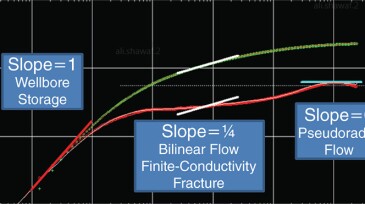
The paper presents key lessons learned in efficiently designing pressure-buildup tests in tight sandstone reservoirs.
-
This paper discusses the challenges presented by factors such as infrastructure, types of primary energy, and investment.
-
The paper describes an approach to history matching and forecasting that does not require a reservoir simulation model, is data driven, and includes a physics model based on material balance.
-
This paper presents a physics-informed neural network technique able to use information from fluid-flow physics as well as observed data to model the Buckley-Leverett problem.
-
This paper illustrates efforts undertaken to evaluate high-viscosity friction reducers and crosslinked gel products, their successful field application, and the importance of maintaining an effective field/laboratory/field cycle.
-
Whether it be Derrick Turk asking us to “resist the temptation to accrue vocabulary rather than understanding” or Mark Bentley telling us that “if you can sketch it you can model it,” there does seem to be a growing pushback against the notions that the modeling/simulation process can be successfully shrink-wrapped and that fundamental understanding is increasingly a …
-
This paper provides a comprehensive study for offshore carbon-dioxide (CO2) storage projects, identifying critical elements for estimation, injection, containment, and monitoring of CO2 plumes.
-
This paper evaluates learnings from the past 30 years of methods that aim to quantify the uncertainty in the subsurface using multiple realizations, describing major challenges and outlining potential ways to overcome them.
-
A study of a limited number of decommissioned oil and gas wells in England found no evidence of methane leaks, including four wells found to be leaking in an earlier study.




![Hero_England decomm study Map[2].jpg](https://assets.spe.org/dims4/default/1340410/2147483647/strip/true/crop/1024x572+0+111/resize/365x204!/quality/90/?url=http%3A%2F%2Fspe-brightspot.s3.us-east-2.amazonaws.com%2Ff1%2Fa7%2Faf022d414b7fa6e8095a8c91b91e%2Fhero-england-decomm-study-map2.jpg)