Reservoir

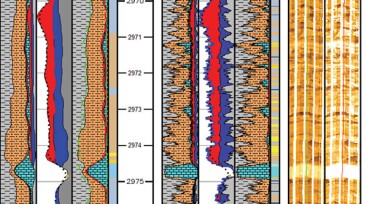
This paper aims to establish a set of best practices for generating particle-size-distribution data from core samples.

This paper discusses the successful execution of two openhole gravel-pack completions in two Gulf of Mexico fields with depleted reservoirs.

This study explores the carbon-capture and mineralization potential of ultramafic rock powders when exposed to flue gases generated from combustion of crude oil and mesquite-derived charcoal.
-
 As the discovery rate of new hydrocarbon resources decreases, the need for more-efficient enhanced-oil-recovery processes increases. Unlike in the past, however, when the efficiency was defined in terms of maximizing the recovery factor (RF), the new interpretation of efficiency is based on optimizing the balance between RF and the reduction of carbon footprint.
 -
This paper reveals the potential of an in-situ generated gel system designed with a bionanoparticle that has tunable strength and gelation reversibility in porous media for underground applications.
-
The newly formed SPE Hydraulic Fracturing Technical Section is working on a project to identify a set of best practices for completions engineers. Once completed, they will be accessible to the entire SPE technical community.
-
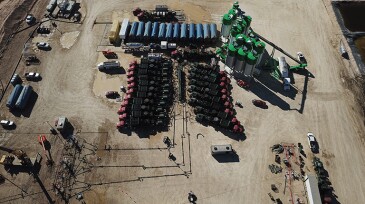
Mixing dry polymer powder and water to make friction reducer as needed during fracturing can cut the cost of the additive and the testing of whether a drastically simplified recipe performs as well as more-complex mixes.
-
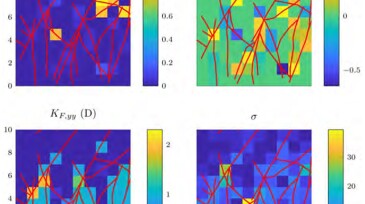
This paper analyzes several configurations of convolutional neural networks suited for predicting upscaled fracture permeabilities and shape factors required to close a dual porosity/dual permeability model.
-
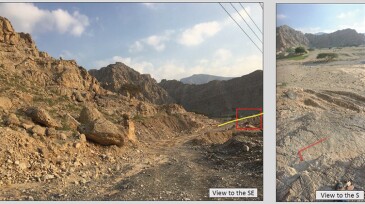
The authors write that simple and straightforward observations on outcrops can be used to build 3D models that mimic geological relationships accurately.
-
In this study, the authors show that high-temperature, high-salinity polymers can exhibit low adsorption and retention in carbonate reservoir rock at ultrahigh salinity conditions.
-
In this paper, a complete safety-management approach and a contingency plan are developed for carbon dioxide waterless fracturing operations.
-
This paper presents an integrated work flow to model mechanical properties at sufficiently high resolution to honor accurately rock fabric and its effects on height and complexity and, thus, production.
-
The utility of mud gas data so far has been limited to fluid typing, formation evaluation, and interwell geological and petrophysical correlation. The ongoing digital transformation has presented the opportunity to increase the utility of, and get more value from, the abundant and rich mud gas data. This article raises the question of whether getting more from mud gas…