Unconventional/complex reservoirs

Transaction adds 90,000 net acres and 68,000 BOE/D of production as Crescent expands its South Texas footprint.

This paper aims to establish a set of best practices for generating particle-size-distribution data from core samples.

This paper discusses the successful execution of two openhole gravel-pack completions in two Gulf of Mexico fields with depleted reservoirs.
-
 M&A market activity in the fourth quarter fell from the third-quarter high to $13 billion.
 -
The SPE Hydraulic Fracturing Technology Conference and Exhibition is being held 31 January–2 February in The Woodlands, Texas.
-
Industry leaders are harnessing the power of data to improve efficiencies, eliminate nonproductive time, and reduce Capex.
-
Before 2012, water management for unconventional oil and gas plays was in its infancy and was trying to keep up with operations. Today, many of the initial challenges have been resolved but new challenges persist. What does the future hold for water in the US onshore unconventional plays?
-
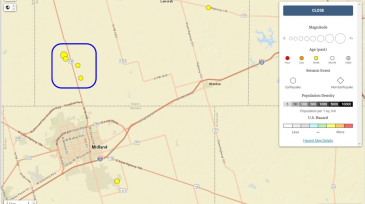
The Railroad Commission of Texas is inspecting injection wells in the Gardendale Seismic Response Area where a magnitude 5.3 earthquake and multiple aftershocks struck.
-
ProPetro will provide committed services for a 3-year period to an undisclosed Permian Basin operator.
-
The deal awards the first concession in the Middle East for unconventional oil resources.
-
A pair of innovative field development strategies are helping tame the wild, wild Permian Basin.
-
Geosteering is supposed to ensure the wellbore stays in the most-productive zone, but a recent study suggests it often misses the mark.
-
This case study presents results achieved in Romania, Mexico, and Kuwait with the use of a series of innovations featuring integrated bottomhole assemblies. A push-the-bit system combines high-performance drilling with precise directional control.