Well integrity/control

A report commissioned by Havtil, the Norwegian Ocean Industry Authority, calls for better dialogue regarding pore-pressure uncertainty and higher-end drilling techniques like managed pressure drilling as methods to reduce the risk of well-control events.

This paper presents a study that confirms glass-reinforced-epoxy-lined tubing as a reliable, cost-effective solution for long-term water-injection service in moderate-salinity offshore environments.

This paper introduces in-pipe inspection technologies enabling high-resolution digital measurements of tubular internal diameter and wall thickness for critical downhole applications.
-
 This paper describes experiences, challenges, and approaches to solving the problems related to creating an advanced early kick-detection system suitable for floating mobile offshore drilling units.
 -
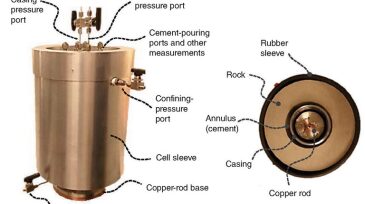
Operators in the North Sea have been concerned about the ability of the cement sheath to maintain sealing integrity because of the increasing number of reported failures in mature wells. This paper presents results from a new laboratory setup to visualize the source of issues.
-
On the basis of safety performance results achieved through automation downstream, an operator set out to achieve the same advances in its upstream business.
-
Australian technology developer MezurX is touting its newly introduced flow, density, and mud monitoring system as a significantly better alternative to the widely used Coriolis meter.
-
The tragic blowout of Macondo has triggered many technical and managerial developments in the field of well integrity.
-
The North field offshore Qatar was observed to have a chance of inner annuli becoming charged with shallow-gas pressure with possible communication to other annuli, which was thought to be a well integrity concern.
-
Despite multitier safeguards, blowouts occur. When such accidents happen, rate estimation is an important and daunting task.
-
As deeper and more complex well designs proliferate throughout oil and gas fields, well completion methods are challenged and new technologies are emerging to ensure safe, cost-efficient, and optimized completions.
-
Well integrity and well barriers have been part of the exploitation for oil and gas for nearly a century, with the introduction of the blowout preventer (BOP) in the 1920s.
-
Well control training programs for deepwater drillers and key rig personnel are undergoing a major overhaul that has been years in the making.