

cementing
-
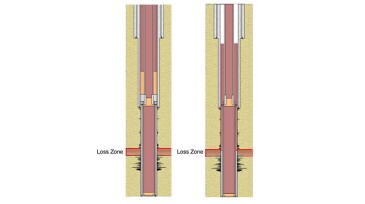
 As managed pressure drilling gains traction, its principles are influencing a wider range of well-construction activities.
 -
The authors reach conclusions that the industry should define a standard testing method to improve swelling performance, including validation of repeatability, to complement existing guidelines.
-
This paper presents the development of an advanced simulation tool aimed at providing a better understanding of the complex fluid-displacement phenomena present in well-cementing processes.
-
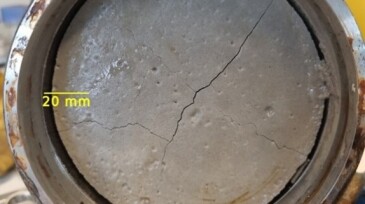
This paper examines the effects of cement voids and microannuli on the collapse resistance of pipe/cement/pipe systems with void angles ranging from 0º to 70º.
-
This paper expands the understanding of geopolymer/microsphere interactions and presents design considerations for alternative cementing materials under low-temperature regimes.
-
This paper presents the characterization and comparison of a metakaolin-based geopolymer as a candidate treatment for remedial operations in oil and gas wells versus conventional state-of-the-art materials.
-
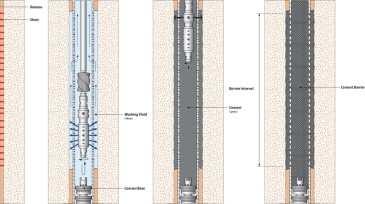
This paper presents a comprehensive literature review of perforate, wash, and cement techniques that compares new methods with traditional ones and uses field cases and computational fluid dynamics to find the most cost- and time-effective practices without sacrificing safety.
-
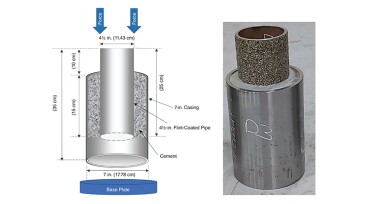
This paper addresses the deployment of an external protective coating with a rough surface profile in wells identified as susceptible to common cementing issues.
-
This paper provides examples for planning and execution of primary and remedial managed pressure cementing in deepwater drilling operations.
-
This paper presents a lost-circulation model used during design and job-evaluation phases to accurately predict top of cement and equivalent circulating densities.



Page 1 of 3