machine learning
-
 A challenging problem of automated history-matching work flows is ensuring that, after applying updates to previous models, the resulting history-matched models remain consistent geologically.
 -
In collaboration with Stanford University and Brown University, Google explores how existing knowledge in an organization can be used as noisier, higher-level supervision—or, as it is often termed, weak supervision—to quickly label large training data sets.
-
In this study, the authors investigated a fully data-driven approach using artificial neural networks (ANNs) for real-time virtual flowmetering and back-allocation in production wells.
-
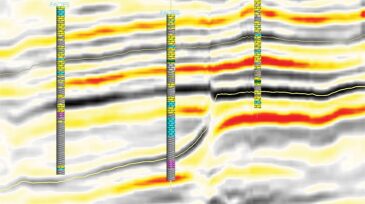
This paper discusses a project with the objective of leveraging prestack and poststack seismic data in order to reconstruct 3D images of thin, discontinuous, oil-filled packstone pay facies of the Upper and Lower Wolfcamp formation.
-
When you think of “data science” and “machine learning,” do the two terms blur together? This article will clarify some important and often-overlooked distinctions between the two to help better focus learning and hiring.
-
Researchers borrowed equations from calculus to redesign the core machinery of deep learning so it can model continuous processes like changes in health.
-
The objective of this case study is to describe a specific approach to establishing an exploration strategy at the initial stage on the basis of not only uncertainty reduction, but also early business-case development and maximization of future economic value.
-
This paper focuses on compressor systems associated with major production deferments. An advanced machine-learning approach is presented for determining anomalous behavior to predict a potential trip and probable root cause with sufficient warning to allow for intervention.
-
Data-driven methods offer significant advantages in the industry, under certain conditions, over conventional methods. But reservations still exist about their use. The paper serves to bridge the gap between unclear understanding of these methods and their successful acceptance and implementation.
-
BHGE is developing an analytics and machine-learning approach that offers descriptive and predictive insights on frac hits, with the aim of eventually offering a real-time monitoring capability to be deployed during frac jobs.