AI/machine learning

Known as Arena, the collaboration aims to improve decision-making across increasingly complex reservoirs and growing volumes of subsurface data.

Robotic and autonomous systems are transforming energy operations, but their full value emerges only when paired with data science, engineering analytics, and AI/ML to turn data into decisions. The transition of the SPE Robotic & Autonomous Systems Technical Section into the SPE Data Science & Engineering Analytics Technical Section helps bridge this critical technolo…
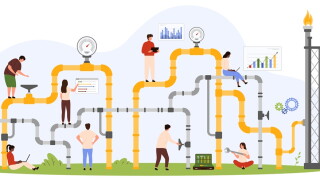
A credible custody-transfer record depends on far more than the accuracy of a single meter. It is the product of an integrated measurement chain. While meter performance supports measurement-system integrity, commercial confidence also depends on traceability, governance, and authorization.
-
 The coronavirus crisis had a devastating effect on oil-company revenues, but it has posed a tough human-resources problem too: how to keep workers safe on cramped rigs at sea where social-distancing is impossible. Many operators have found an answer in technology—specifically, digital twins.
 -
Incorporating imagination into AI agents has long been an elusive goal of researchers in the space. Imagine AI programs that are able not only to learn new tasks but also to plan and reason about the future.
-
The complete paper provides an approach using machine-learning and sequence-mining algorithms for predicting and classifying the next operation based on textual descriptions.
-
The complete paper describes an automated machine-learning approach to determine the spatial variation in decline type curves for shale gas production, based on existing data of production, completion, and geological parameters.
-
In addition to the well-recognized elements of digital transformation such as real-time monitoring, remote intelligence, and extraction of insights from data, there is a need to evolve the industry hardware through application of enhanced edge computing.
-
Deep learning is routinely used in products and services that affect hundreds of millions of lives, despite the fact that no one quite understands how it works. Now, the Office of Naval Research has awarded a $7.5 million grant to a group of researchers who think they can unravel the mystery.
-
“Being mindful is about being intentional,” said Ahmer Inam, chief AI officer at technology consulting firm Pactera Edge. “Mindful AI is about being aware and purposeful about the intention of, and emotions we hope to evoke through, an artificially intelligent experience.”
-
The complete paper discusses optimization of a development plan involving low-salinity water injection.
-
Decline-curve analysis is one of the more widely used forms of data analysis that evaluates well behavior and forecasts production and reserves. This paper presents technologies that apply DCA methods to wells in an unbiased, systematic, intelligent, and automated fashion.
-
Advanced machine-learning methods combined with aspects of game theory are helping operators understand the drivers of water production and improve forecasting and economics in unconventional basins.