Completions

This paper aims to establish a set of best practices for generating particle-size-distribution data from core samples.

This paper discusses the successful execution of two openhole gravel-pack completions in two Gulf of Mexico fields with depleted reservoirs.

By integrating experimental and mathematical modeling approaches, this work aims to advance the understanding of sand-detachment dynamics and formation instability under varying saturation conditions.
-
 SponsoredWell-monitoring technology gives oil companies the data and insights to boost production and derive maximum value from oil and gas wells.
 -
Oil companies would have to pay a premium for the hardware and services needed for rapid expansion. But is that likely?
-
Liberty will be integrating Seismos’ measurements-while-fracturing system into its completions service to analyze near-wellbore fracture networks and create a near-field connectivity index.
-
This paper presents an optimization project that was implemented in the Khazzan and Ghazeer fields of Oman to optimize the post-fracturing cleanup and testing period to reduce hydrocarbon flaring and CO2 emissions as well as the testing cost without compromising the overall well cleanup and testing objectives.
-
Managed-pressure drilling has been associated as a technology used only on problematic wells and only as a last resort. However, when integrated at the beginning of operations as part of a comprehensive well plan, it becomes a performance-enhancing solution for any type of well classification, including development, directional, multilaterals, and horizontals.
-
A team of engineers did something no one had done before: a full-scale fracturing test on the surface. The results surprised the fracturing experts involved.
-
The message from a single chart’s data from the first full-scale hydraulic fracturing surface test is simple: Far less proppant flows out of the first clusters passed in a stage than the last ones.
-
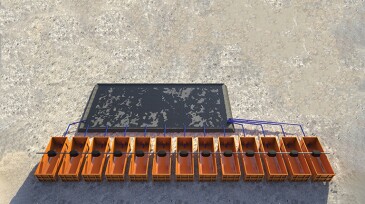
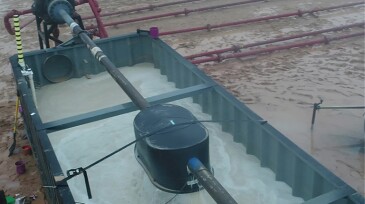
SponsoredFrac operators are continuously challenged by pressures to increase ROI and simultaneously decrease emissions. But is it really possible? New technology released in February from Catalyst Energy Services proves that it is possible. And the results are compelling.
-
Efforts to mitigate the potentially harmful effects of hydraulic fracturing have traditionally been divided along two fronts—those that primarily focus on protecting the environment and wildlife and those that focus on protecting humans and domestic animals. But it doesn’t have to be that way.
-
Induced seismicity put a stop to hydraulic fracturing in the UK, but rising natural gas prices might change that.