Completions

This paper aims to establish a set of best practices for generating particle-size-distribution data from core samples.

This paper discusses the successful execution of two openhole gravel-pack completions in two Gulf of Mexico fields with depleted reservoirs.

By integrating experimental and mathematical modeling approaches, this work aims to advance the understanding of sand-detachment dynamics and formation instability under varying saturation conditions.
-
 The authors develop a methodology that calculates the mechanical specific energy using real-time drillstring acceleration signals directly.
 -
New research from Hess offers compelling evidence that two layers of tight rock can be treated as one and how passive wells can become oil producers.
-
High oil prices will mean more spending on workovers to eke out more oil and gas from older wells. The amount will depend on finding those willing and able to do that tricky work.
-
SponsoredAs world demand for energy increases, enhancing the efficiency of oil and gas production is key. Horizontal and multistage fracturing have made a huge difference in recovery. Fracturing fluids have played a key role in these gains—reducing costs and lessening fracture damage. Now fracturing fluids can be more sustainable as well, helping with your company’s ESG goals.
-
SponsoredCase study on how a Marcellus operator was able to recover 99%+ of frac sand in high flowrate wells using advanced cyclone technology.
-
The paper provides information to engineers for selecting high-viscosity friction reducers and describes a methodology for evaluating damage potential and proppant transport.
-
The principles behind unconventional wells lead to production profiles very different from conventional wells. High initial-production rates drop to much lower rates in a matter of months or a few years. How many in the US are currently considered low-production-rate wells?
-
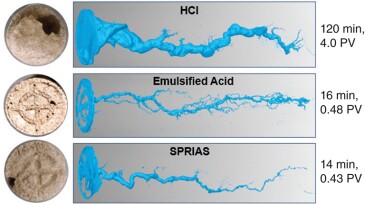
The authors describe the benefits of a single-phase retarded inorganic acid system, which they write features the same benefits as emulsified acids while eliminating the drawbacks of the latter.
-
This paper presents a novel sandstone-stimulation technique using thermochemical fluids.
-
This paper presents a well-integrity-management system developed for a high-pressure/high-temperature gas field in southwest China.