Data & Analytics

The deployment of a new heavy-duty robotic system aims to reduce workforce exposure to high-risk areas while improving detection of potential leaks.

Aramco says it has saved $770 million over the past 3 years from the $70 million it has invested over the same period in corrosion management technologies.

The deal adds physics-based reservoir modeling and real-time decision workflows to SLB’s digital portfolio.
-
 Since 2007, an operator in Nigeria has registered a significant increase of oil-spill events caused by sabotage and oil-theft activities. The technology presented here allows detecting and locating leaks taking place at a distance from the sensor of up to 35 km.
 -
For thin-oil-rim reservoirs, well placement, well type, well path, and the completion methods must be evaluated with close integration of key reservoir and production-engineering considerations.
-
Many business and digital corporations claim that between 100 billion and 200 billion devices could be connected by 2020.
-
A data-driven approach to successfully analyze and evaluate production-fluid impact during facility system divert events is presented. The work flow effectively identifies opportunities for prompt event mitigation and system optimization.
-
Failure to prioritize objectives and improper selection of candidate wells can have significant implications for both derived value and potential risk.
-
Data mining for production optimization in unconventional reservoirs brings together data from multiple sources with varying levels of aggregation, detail, and quality.
-
The big data approach will allow new types of data-driven models to bypass traditional bottlenecks. It is also expected to lead to different views of standard models, thus providing new and valuable insights in the process.
-
The challenges facing the oil and gas industry require crossover technologies from other industries such as aerospace, automotive, and medicine to help drive efficiency, boost productivity, and optimize performance.
-
Permanent downhole gauges (PDGs) provide vast amounts of pressure-transient and rate data which may be interpreted with improved pressure-transient-analysis (PTA) approaches to gain more knowledge about reservoir dynamics.
-
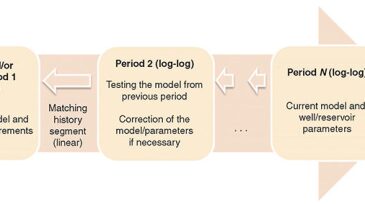
This paper proposes a framework based on proxies and rejection sampling (filtering) to perform multiple history-matching runs with a manageable number of reservoir simulations.