Data & Analytics

Switching from continuous circulation to cyclic huff-‘n’-puff operation in enhanced geothermal systems can significantly delay thermal breakthrough, sustain higher production temperatures, and improve long-term economic performance.

The two companies say they plan to work together to use agentic AI to increase the capabilities of technical experts.

This article is the first in a Q&A series from the SPE Methane Emissions Management Technical Section (MEMTS) on methane intelligence and how oil and gas teams translate emissions data into credible decisions and measurable reductions.
-
 Anomalies in heart function can be diagnosed in real time by measuring an electrical signal. Petroleum engineers have adapted the concept to diagnose anomalous drilling conditions in real time using a shock signature recorded downhole.
 -
Oslo-based consultancy Rystad Energy sees the potential for robots and automation to replace up to 400,000 roles in North America, Europe, and Russia by 2030. The timeline is not guaranteed, though, and will move at a speed set by human decision making.
-
The company’s newest product will combine with Amazon Web Service’s efforts to ease access to data from the Open Subsurface Data Universe.
-
For oil and gas companies to remain in existence in the second half of the 21st century, they must find ways to dramatically reduce, if not eliminate, their output of carbon dioxide and other greenhouse gases. Artificial intelligence technology could provide one tool to help the energy industry accomplish that staggeringly difficult goal.
-
Scientists at the Sandia National Laboratories are using machine learning to find methane hydrates on the seafloor, using an approach similar to weather forecasting.
-
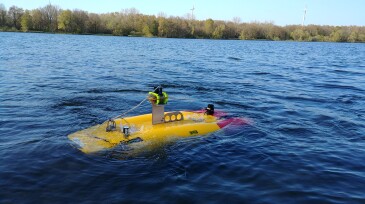
The new DeeperSense project, an international consortium led by the German Research Center for Artificial Intelligence, is working on technologies that combine the strengths of visual and acoustic sensors with the help of artificial intelligence. The aim is to significantly improve the perception of robotic underwater vehicles.
-
The infrastructure engineering software firm is expected to pay more than $1 billion to acquire geological and geophysical modeling software developer Seequent.
-
Honeywell's H1 quantum system has reached a record-high quantum volume.
-
According to a World Economic Forum report, digital transformation in the oil and gas industry could unlock approximately $1.6 trillion of value for the industry, its customers, and wider society while creating around $1 trillion of value for oil and gas firms.
-
Start-and-stop data management initiatives and a mishmash of partial solutions are no longer viable for managing the digital oil field. Data management should be transformed from a cost center to a cash-flow-generating function.