Formation damage

This paper presents the methodology for developing drill-in organophilic clay-free invert-emulsion-fluid technology that enhances well production through fundamental geological studies and fluid testing.

This paper presents laboratory-testing methods and evaluation criteria designed to improve understanding of both the origin and extent of formation damage associated with CO2 injection.

This work introduces an analytical model for nonisothermal CO2 injection that accounts for both Joule-Thomson cooling and interformation heat exchange.
-
 For the development of the Dvalin high-pressure/high-temperature (HP/HT) gas field in the Norwegian Sea, a completion scheme using standalone screens is planned.
-
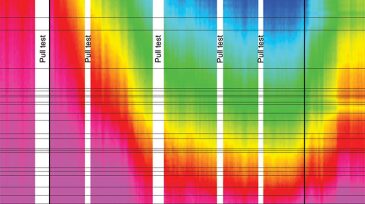
Wells in deepwater reservoirs show significant rate decline with time as the result of various causes. A diagnostic tool for quantification of factors influencing well-productivity decline is presented in this paper.
-
The success of water-conformance operations often depends on clear identification of the water-production mechanism. Such assessment can be complicated significantly when formation damage is also occurring.
-
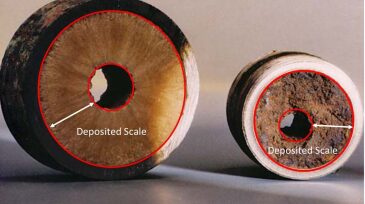
Scaling buildup inside wellbores is a serious production problem that dramatically reduces the well productivity index. This issue has a significant cost across the industry, mostly associated with loss of production or additional operations such as well intervention.
-
Formation damage: Do we always need to have a high focus on its prevention, or do occasions exist when it really does not matter?
-
A high-carbon-dioxide (CO2) carbonate gas field offshore Sarawak, Malaysia, is scheduled for development. Reservoirs in this region have an average clay content of 8%; more than 50% of this clay content is migratory illite, and 15% is migratory kaolinite.
-
This paper describes a coreflooding program performed with sandpacks at different permeabilities, water qualities, and injection conditions.
-
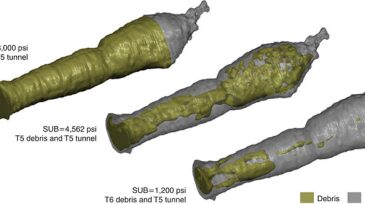
Because of inherent complexities, understanding the characteristics of perforations in downhole environments is a significant challenge. Perforation-flow laboratories have been used to provide insight into cleanup and productivity mechanisms around perforation tunnels.
-
This paper presents the planning and execution of a matrix-stimulation pilot project in the heavy-oil Chichimene Field in Colombia.
-
Coreflooding is one of the principal tools through which we qualify drilling and completion fluids and assess the potential for formation damage, but is it relevant? By “relevant,” I mean does it give an accurate portrayal of the likely performance of the selected fluids.