Fracturing/pressure pumping

The Seismos full-scale research center opens to industry, universities, and national laboratories, advancing acoustic sensing across upstream energy, pipelines, critical infrastructure, and national security.

This article from the SPE Research and Development Technical Section offers new insights to how the upstream industry can benefit from the emergence of quantum computing.

This contributed article highlights the growing importance of fiber-optic sensing and its potential to advance thanks to emerging quantum technologies.
-
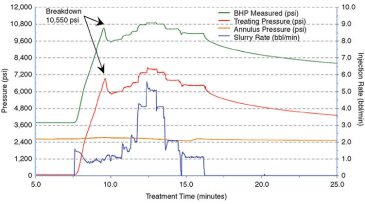
 In hydraulic fracturing, the use of diagnostic-fracture-injection tests (DFITs) can provide valuable information.
 -
GE Staoil Open Innovation Challenge results in new proppant ideas.
-
Enventure Global Technology is working to convince operators that its solid expandable steel liners perform better than chemical diverter agents for refracturing operations. Its technology is called the ESeal ReFrac Liner.
-
Price competition among makers of perforating guns has gotten brutal, even by the rough standards of unconventional oil business where depressed oil prices have led to deep budget cuts.
-
This paper will discuss the hydraulic-fracturing-stimulation design, execution, and evaluation for the first successful proppant-fracturing treatment in an unconventional carbonate source rock in Saudi Arabia.
-
Low oil prices look like something the industry needs to get used to. “This will be with us for a while,” said Rex Tillerson
-
When it comes to fracturing, experts argue about many things, but they agree that fractures do not look like lightning bolts, tree roots, or shattered glass.
-
As shale operators look for ways to survive amid the current downturn in oil prices, accelerating the refracturing of older horizontal wells is turning into one of the most attractive options.
-
For more than 50 years pressure transient tests have been used to model conventional reservoir properties in wells all over the world. In unconventional reservoirs, it was first assumed this kind of test could not be done; however, a sensitive pressure gauge technology makes it possible.
-
This paper reviews two newly developed novel completion systems that significantly reduce time spent performing multistage stimulation in environments where cost and consequence of failure are high.