Fracturing/pressure pumping

The creation of SPE’s Acid Stimulation Technical Section shines a light on the technique that improves injectivity and productivity. JPT talked with the chair of the new section about the importance of the technical area.

Fracture modeling continues to be used to evaluate and design novel applications, and integration with diagnostics and other forms of field-data collection are crucial to success.

This paper focuses on a replicable, quantitative workflow using completions-process simulation software.
-
 Casing deformation has emerged as a major challenge in China’s unconventional oil and gas fields, prompting the development of new solutions to address the issue.
-
The US supermajor is using one of its lowest-value hydrocarbon products to generate double-digit production increases in its most prolific US asset.
-
The collaboration has announced Closed Loop Fracturing, which combines real-time subsurface data with automated surface control.
-
Researchers with the National Energy Technology Laboratory showed that naturally occurring signals in underground fluids can serve as effective indicators of flow patterns between existing wellbores. Understanding these patterns can lead to increased efficiency and safety.
-
The upstream industry has viewed real-time completions as a long-term goal, but the technology is already in use.
-
This study aims to thoroughly assess the influence of various completions, fracturing stimulation, and intrinsic reservoir properties affecting the productivity of 10 major unconventional plays while uncovering insights and trends unique to each play.
-
This paper investigates condensate-banking effects on well performance by conducting field-modeling studies on Delaware Basin deep Wolfcamp condensate producers using compositional simulation models with hydraulic fractures.
-
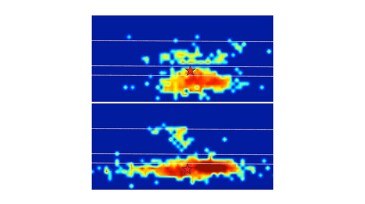
In this work, microseismic observations are integrated with strain and other observations to investigate the microseismic response in relation to the underlying hydraulic fracture geometry for different rock types.
-
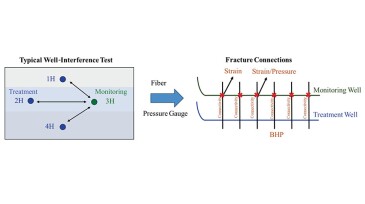
This work proposes a method to interpret far-field strain-change and pressure data to quantify fracture connectivity and properties at the cluster level.
-
Modern completions often are equipped with downhole measurement devices that provide critical real-time data not only during the hydraulic fracturing treatment but also during the ensuing production phase.