HSE & Sustainability

While Uzbekistan has seen a significant drop in flaring, methane leaks from deteriorating infrastructure continue to reveal themselves to satellites in space.

The department announced it plans to combine the Bureau of Offshore Energy Management and the Bureau of Safety and Environmental Enforcement into the Marine Minerals Administration.
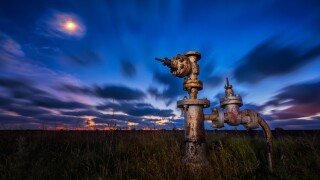
While some idle wells may be brought back into production, many will be plugged and abandoned. This paper considers repurposing certain idle oil and gas wells by using their empty steel casing for the disposal of nuclear waste.
-
 Discussed are real-world examples of the less often considered but valuable environmental benefits delivered via MPD.
 -
The complete paper examines the decision to use hydrogen-sulfide- (H2S) removal technology, the cost of operation, and the unit’s availability over its lifetime.
-
In the complete paper, the authors seek to understand the effect of triazine on the electrochemical response of a carbon-steel surface in a mixed-gas system.
-
This paper describes studies that confirm that enzyme-based, environmentally preferable chemistries can be used to break polymers and mitigate H2S in various systems.
-
The oil and gas sector has always been inherently risky. No matter how far mitigating efforts go or by how much technology improves, it is unlikely that risk will be removed entirely anytime soon. That being said, the sector has made huge strides in recent years to better protect those who serve it.
-
On 13 August 2020, EPA Administrator Andrew Wheeler announced two final rules related to the New Source Performance Standards (NSPS) for the oil and natural gas industry.
-
Lloyd’s Register has partnered with STC Global to create an artificial intelligence tool expected to provide insight from incident data captured by HSE functions but left untapped.
-
The company’s latest sustainability report highlights progress despite the disruption caused by the COVID-19 pandemic.
-
Williams Companies announced a near-term goal of a 56% absolute reduction from 2005 levels in greenhouse-gas emissions by 2030, aiming for net-zero carbon emissions by 2050. Why is this significant, and where can emissions be mitigated in the midstream natural-gas gathering and boosting segment?
-
The International Association of Oil and Gas Producers and IPIECA, the industry group focused on environmental and social performance, have released their annual assessment of health performance in the industry. The report is based on voluntary reporting from the two groups’ member companies.