HSE & Sustainability
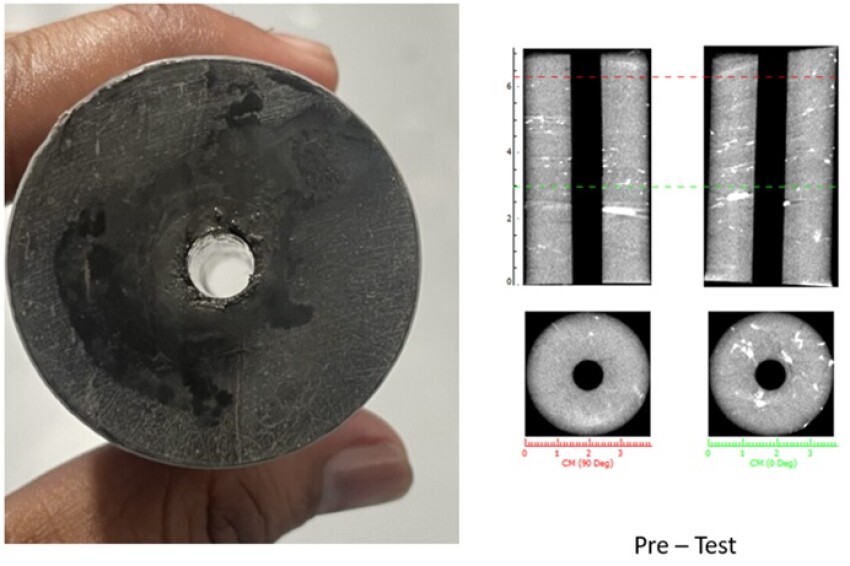
An investigative study examines the use of creeping shale formations as a more durable alternative to conventional cement barriers in carbon dioxide storage wells, potentially enabling safer long-term underground carbon storage.

The companies have released the Event Learning Taxonomy CLUE, which aims to improve the understanding of incidents beyond individual blame and toward clearer reporting and increased learning.
A memorandum of understanding between the companies targets technical services for safety and performance across Egypt’s onshore and offshore assets.
-
 In this study, samples of flowback water and downhole shales are analyzed to investigate the mechanisms controlling the chemistry of flowback water.
 -
At the 2016 Unconventional Resources Technology Conference, Barry Donaldson, vice president of global sales and marketing at Tetra Technologies, discussed possible cost-effective water management strategies.
-
Research and development firm Battelle is working on a new induced-seismicity study that aims to help wastewater disposal well operators in Ohio stay on the good side of state regulators.
-
The deepwater industry uses technology qualification (TQ) as a tool to determine which safety barriers are needed, and what level of testing is required. Even without failure data from the field, a method has been developed to quantify the integrity of various components.
-
This paper presents a multiple-physical-barrier (MPB) approach to operational risk management by focusing on physical barriers and success paths that enable each barrier to perform its safety functions.
-
Optical gas-imaging is effective for visual identification of volatile organic compound (VOC) leaks. But it doesn't currently quantify the leak rate as required by regulations. This paper discusses work aimed at adding that quantification.
-
Ghana’s fishers and coastal communities have raised concerns over the effects of offshore oil exploration and production relating to the giant Jubilee field. This paper describes the process and results of the multistakeholder approach to solving marine-zone conflicts.
-
Risk-taking behavior is an important contributing human factor to incidents and is notoriously difficult to influence. This study examined how safety measures and uncertainty affected the risk-taking behavior of participants.
-
This paper explores whether factors other than the driver can be influenced to increase overall driving safety. This is an application of the risk management approach of using fundamental design and layout to reducing the likelihood and severity of incidents.
-
This paper reviews the Ebola outbreak from the viewpoint of an onshore and offshore petroleum operator, providing insight into the real threats the outbreak, and providing lessons learnt for industry operations elsewhere.