Production

This paper aims to establish a set of best practices for generating particle-size-distribution data from core samples.

Unlike traditional AI approaches that rely primarily on historical data, physics-based AI integrates physical laws, engineering expertise, and operational constraints directly into the learning process. Three recent SPE papers illustrate how this paradigm is transforming the industry through intelligent condition monitoring, virtual sensing, and autonomous production …

This research focuses on combining physics-based expert rules with machine learning to improve the detection of failure-related events in electrical submersible pumps.
-
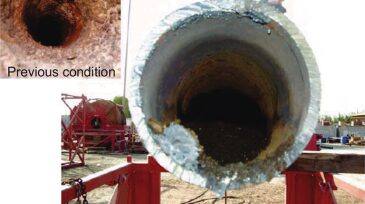
 The gas-producing carbonate zones of the Ghawar field in eastern Saudi Arabia have been affected by extensive iron sulfide (FeS) scale deposition, reducing overall gas production and increasing risks during well interventions.
 -
This paper describes various sulfide inhibitor-testing techniques that have been applied to candidate products for the management of zinc sulfide (ZnS) and lead sulfide (PbS) in a gas/condensate field with a known relatively severe ZnS/PbS scaling problem.
-
Critical to success is the accurate testing in the laboratory that best approximates field conditions.
-
Ferrous sulfide (FeS) precipitation increases during shale-gas and -oil production because of increased biologically and thermally induced sulfide production. Although FeS scale is abundant, little is understood about its precipitation and inhibition properties.
-
Mixed carbonate-/sulfide-scale problems have been reported when water is produced from carbonate reservoirs. This study presents interactions of lead sulfide and zinc sulfide coprecipitating with calcite.
-
In artificial-lift applications, a new anchoring device for insertable progressing-cavity pumps (I-PCPs) extends I-PCP applications to a larger set of candidate wells.
-
The new approach joins well performance from production-system analysis and true valve performance from the VPC database to form an integrated system performance tool.
-
This paper describes the use of a root-cause-failure-analysis (RCFA) process to improve artificial-lift-system performance in a project in Chad.
-
The digital repository of our valuable SPE papers was first launched as the SPE eLibrary in 1997 and subsequently was updated as OnePetro in 2007. This great collection has become a valuable resource for our global industry.
-
It was established that improving the reliability of the TH-connector system has a direct effect on the unintervened life of the ESP electrical system.