Reservoir characterization

Known as Arena, the collaboration aims to improve decision-making across increasingly complex reservoirs and growing volumes of subsurface data.

Three papers are highlighted as the primary contributions because of their broad industry relevance. They focus on improving formation particle-size characterization, expanding the application of openhole gravel packs in depleted and compartmentalized reservoirs, and advancing the understanding of capillary pressure in sand production.

By integrating experimental and mathematical modeling approaches, this work aims to advance the understanding of sand-detachment dynamics and formation instability under varying saturation conditions.
-
 Petrolern has received a $1.15-million grant from the US Department of Energy to develop and commercialize its technology that models in-situ stresses by using available data.
 -
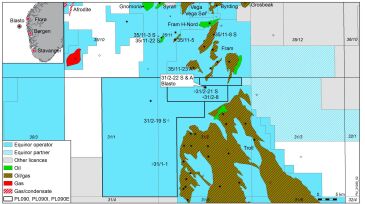
The Norwegian Petroleum Directorate and Equinor have announced the biggest discovery so far this year on the Norwegian Continental Shelf. Three wildcat wells drilled in the Blasto prospect near the Fram field confirmed the find and were then permanently plugged and abandoned.
-
Algorithms are taking over the world, or so we are led to believe, given their growing pervasiveness in multiple fields of human endeavor such as consumer marketing, finance, design and manufacturing, health care, politics, and sports. The focus of this article is to examine where things stand in regard to the application of these techniques for managing subsurface en…
-
Deciding whether to develop a new discovery is often about the data. Without the correct understanding of the fluids in the reservoir, projects are unlikely to turn out as planned.
-
The authors develop an innovative machine-learning method to determine salt structures directly from gravity data.
-
An appropriate work flow of combining suitable advanced technologies can help to overcome the long-standing challenges of sub-basalt imaging.
-
Most of today’s equipment and interpretation methods are indeed not new. After all, well testing has been around for nearly a century, resulting in a legacy that may not always look cutting-edge, but these tried-and-true tools were so technologically remarkable that they became staples.
-
The work and the provided methodology provide a significant improvement in facies classification.
-
The authors introduce and compare two quality-control approaches based on two different signal-processing practices.
-
Innovators at the Norwegian oil company have developed a machine-learning model that analyzes mud-gas data to predict the gas/oil ratio of wells as they are drilled—something that the industry has worked for decades to accomplish.