Reservoir simulation

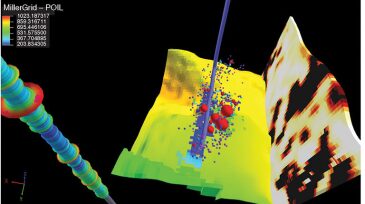
This paper presents a case study from a mature field redevelopment project where pulsed neutron logging was integrated with advanced reservoir modeling to improve the understanding of fluid-contact dynamics and optimize new horizontal well placement.

This paper aims to showcase examples of how integrated analysis of surveillance data in the Azeri-Chirag-Gunashli field has improved reservoir understanding and informed reservoir-management decisions.

This work applies fuzzy logic, a well-established artificial-intelligence technique, to quantitatively assess connectivity between injectors and producers in a giant presalt field in the Santos Basin of Brazil.
-
 Permanent downhole gauges (PDGs) can provide a continuous record of flow rate and pressure, which provides extensive information about the reservoir. In this work, a machine-learning framework based on PDG data was extended to two applications: multiwell testing and flow-rate reconstruction.
 -
In this paper, the authors introduce a novel semianalytic approach to compute the sensitivity of the bottomhole pressure (BHP) data with respect to gridblock properties.
-
This paper critically investigates the impact of using realistic, inaccurate simulation models. In particular, it demonstrates the risk of underestimating uncertainty when conditioning real-life models to large numbers of field data.
-
History matching is only one part of something more comprehensive—reservoir modeling.
-
In this paper, the authors derive and implement an interwell numerical simulation model (INSIM) that can be used as a calculation tool to approximate the performance of a reservoir under waterflooding.
-
Acquiring new 3D broadband seismic data of a gas field containing legacy 3D conventional towed-streamer seismic data.
-
Although the wellbore is in a nonisothermal environment, heat transfer between the fluid in the wellbore and the formation is often ignored and temperature is usually assumed constant in data interpretation, which will lead to misunderstanding of the pressure profile.
-
Developers of the latest generation of unconventional hydraulic fracturing models are hoping that current weak oil and gas prices will generate newfound interest in their software technology.
-
For engineering design teams, the market downturn is an opportunity to review practices and learn from others who have used hard times to reshape processes through simulation while cutting development time and costs.
-
Conventional miscible- or near-miscible-gasflood simulation often overestimates oil recovery, mostly because it does not capture a series of physical effects tending to limit interphase compositional exchanges.