Reservoir simulation

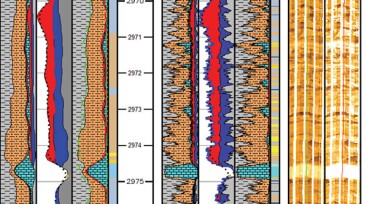
This paper presents a case study from a mature field redevelopment project where pulsed neutron logging was integrated with advanced reservoir modeling to improve the understanding of fluid-contact dynamics and optimize new horizontal well placement.

This paper aims to showcase examples of how integrated analysis of surveillance data in the Azeri-Chirag-Gunashli field has improved reservoir understanding and informed reservoir-management decisions.

This work applies fuzzy logic, a well-established artificial-intelligence technique, to quantitatively assess connectivity between injectors and producers in a giant presalt field in the Santos Basin of Brazil.
-
 This paper presents a physics-informed neural network technique able to use information from fluid-flow physics as well as observed data to model the Buckley-Leverett problem.
 -
Whether it be Derrick Turk asking us to “resist the temptation to accrue vocabulary rather than understanding” or Mark Bentley telling us that “if you can sketch it you can model it,” there does seem to be a growing pushback against the notions that the modeling/simulation process can be successfully shrink-wrapped and that fundamental understanding is increasingly a …
-
This paper evaluates learnings from the past 30 years of methods that aim to quantify the uncertainty in the subsurface using multiple realizations, describing major challenges and outlining potential ways to overcome them.
-
Schlumberger announced that ConocoPhillips will use its DELFI platform to move its data to the cloud.
-
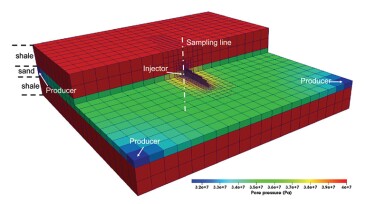
This paper introduces methods to fully couple reservoir simulation with wellbore flow models in fractured injection wells.
-
The paper presents a model for shale gas production in which CO2 is injected by huff ’n’ puff into a hydraulic fracture surrounded by a shale matrix.
-
This study explores pitfalls experienced when using capacitance/resistance modeling as a plug-and-play technique for waterflood optimization and discusses workarounds and mitigations to improve its reliability.
-
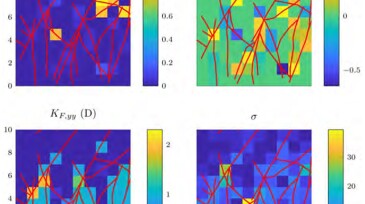
This paper analyzes several configurations of convolutional neural networks suited for predicting upscaled fracture permeabilities and shape factors required to close a dual porosity/dual permeability model.
-
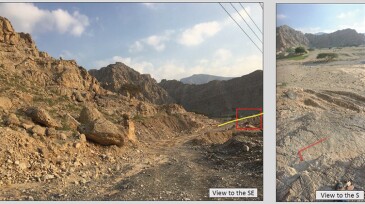
The authors write that simple and straightforward observations on outcrops can be used to build 3D models that mimic geological relationships accurately.
-
This paper presents an integrated work flow to model mechanical properties at sufficiently high resolution to honor accurately rock fabric and its effects on height and complexity and, thus, production.