Reservoir simulation

Known as Arena, the collaboration aims to improve decision-making across increasingly complex reservoirs and growing volumes of subsurface data.
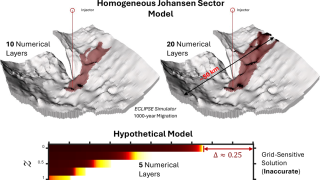
A new framework combines analytical and numerical insights, extending vertical equilibrium modeling and guiding reservoir-scale implementation, providing reservoir engineers with practical guidance for assessing accuracy across flow regimes and long-term carbon-dioxide migration.

This article from the SPE Integrated Reservoir Management Technical Section (IRMTS) examines the closed-loop IRM approach, from insight to execution to learning, and the limits of technology-driven solutions.
-
 A critical step in proper design and optimization of any chemical-enhanced-oil-recovery (CEOR) process is appropriate and precise numerical simulations.
 -
This study explores the mechanisms contributing to oil recovery with numerical modeling of experimental work and investigates the effects of various parameters on oil recovery.
-
This paper describes the first job in southeast Asia in developing horizontal-well placement in a turbidite environment.
-
Producers face a number of decision-making challenges. Specifically, they must optimize field development and operational decisions in light of the complex interplay of fiscal, market, and reservoir variables.
-
The story of unconventional oil and gas technology development has been focused on fractures. The formula has been more stages, more sand, and more water, targeting the most productive spots.
-
The optimization algorithm used in this work is a hybrid genetic algorithm (HGA), which is the combination of GAs with artificial neural networks (ANNs) and evolution strategies (ESs).
-
Reservoir-simulation-model inputs are numerous, and uncertainty is pervasive—before, during, and after development. With the pressure to deliver results quickly, how do we find the right balance?
-
In upstream oil and gas, cloud computing is very immature because the industry has always been challenged by storage and computational capability. However, high-performance cloud computing may create an opportunity for smaller companies lacking infrastructure for scientific applications.
-
Computational advances in reservoir simulation have made possible the simulation of thousands of reservoir cases in a practical time frame. This enables exhaustive exploration of subsurface uncertainty and development/depletion options.
-
This paper describes how seismic reservoir integration, advanced production analysis, and accurate nanoscale and 3D full-field simulations may address profitability issues and help oil companies to be more efficient in developing unconventional portfolios.