Reservoir simulation

Known as Arena, the collaboration aims to improve decision-making across increasingly complex reservoirs and growing volumes of subsurface data.
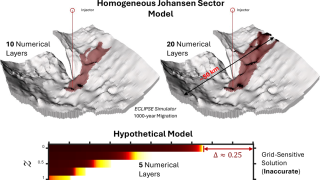
A new framework combines analytical and numerical insights, extending vertical equilibrium modeling and guiding reservoir-scale implementation, providing reservoir engineers with practical guidance for assessing accuracy across flow regimes and long-term carbon-dioxide migration.

This article from the SPE Integrated Reservoir Management Technical Section (IRMTS) examines the closed-loop IRM approach, from insight to execution to learning, and the limits of technology-driven solutions.
-
 A detailed comparison of two leading software platforms demonstrates the effective application of these platforms in modeling complex reservoir dynamics and biochemical reactions in geological formations for risk assessment in underground hydrogen storage.
 -
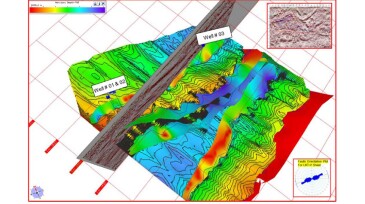
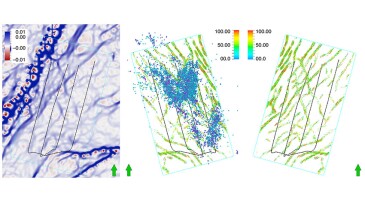
The main goal of this research work was to determine subseismic faults and fracture corridors and their characteristics, including density and orientation, for a Paleocene fractured carbonate reservoir.
-
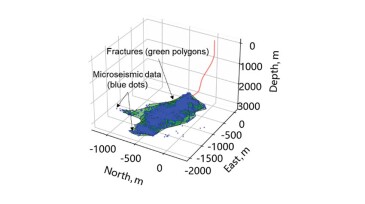
In this paper, an energy-based 3D fracture-reconstruction method is proposed to derive the complex fracture network from microseismic data in a shale gas reservoir.
-
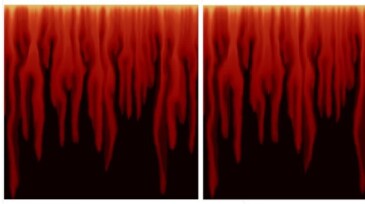
A numerical simulation study based on experimental data of 2D and 3D models is presented to examine immiscible fingering during field-scale polymer-enhanced oil recovery.
-
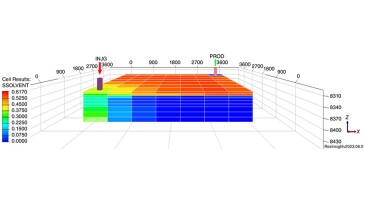
The authors present an open-source framework for the development and evaluation of machine-learning-assisted data-driven models of CO₂ enhanced oil recovery processes to predict oil production and CO₂ retention.
-
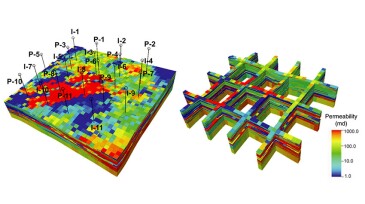
The authors of this paper propose hybrid models, combining machine learning and a physics-based approach, for rapid production forecasting and reservoir-connectivity characterization using routine injection or production and pressure data.
-
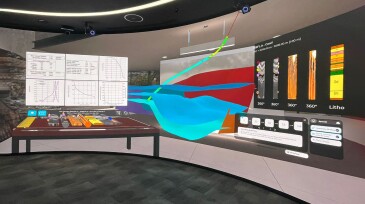
Virtual reality and related visualization technologies are helping reshape how the industry views 3D data, makes decisions, and trains personnel.
-
This paper presents a specialized workflow that aims to quantify the severity of condensate banking and subsequently optimize reservoir development strategies for a deep formation in the Permian Basin.
-
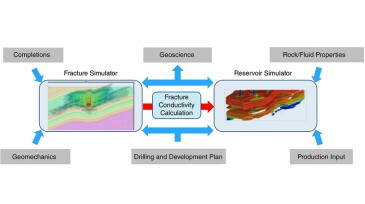
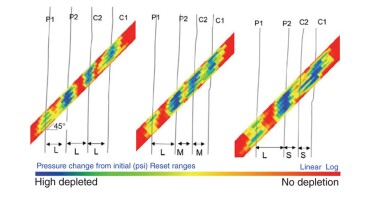
This paper describes numerical modeling studies of fracture-driven interactions using a coupled hydraulic-fracturing-propagation, reservoir-flow, and geomechanics tool.
-
A proposed integrated workflow aims to guide prediction and mitigating solutions to reduce casing-deformation risks and improve stimulation efficiency.