Reservoir simulation
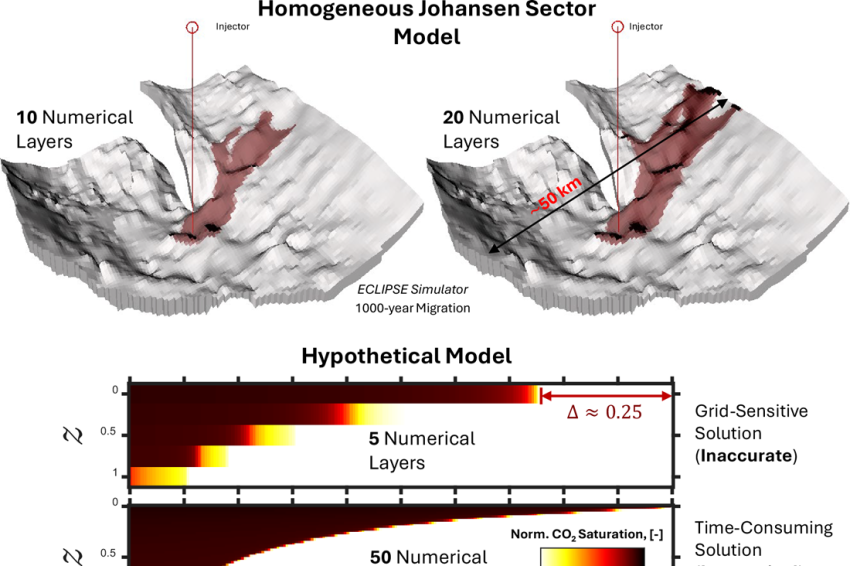
A new framework combines analytical and numerical insights, extending vertical equilibrium modeling and guiding reservoir-scale implementation, providing reservoir engineers with practical guidance for assessing accuracy across flow regimes and long-term carbon-dioxide migration.

This article from the SPE Integrated Reservoir Management Technical Section (IRMTS) examines the closed-loop IRM approach, from insight to execution to learning, and the limits of technology-driven solutions.

This paper presents a reduced physics-based model that accelerates the ability to screen infill-location optimization, using the fast marching method to maximize production for a reservoir with multiple realizations.
-
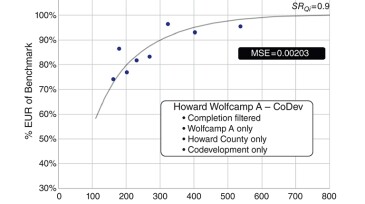
 The complete paper builds on existing tools in the literature to quantify the effect of changing well spacing on well productivity for a given completion design, using a new, simple, intuitive empirical equation.
 -
The paper describes an approach to history matching and forecasting that does not require a reservoir simulation model, is data driven, and includes a physics model based on material balance.
-
This paper presents a physics-informed neural network technique able to use information from fluid-flow physics as well as observed data to model the Buckley-Leverett problem.
-
Whether it be Derrick Turk asking us to “resist the temptation to accrue vocabulary rather than understanding” or Mark Bentley telling us that “if you can sketch it you can model it,” there does seem to be a growing pushback against the notions that the modeling/simulation process can be successfully shrink-wrapped and that fundamental understanding is increasingly a …
-
This paper evaluates learnings from the past 30 years of methods that aim to quantify the uncertainty in the subsurface using multiple realizations, describing major challenges and outlining potential ways to overcome them.
-
Schlumberger announced that ConocoPhillips will use its DELFI platform to move its data to the cloud.
-
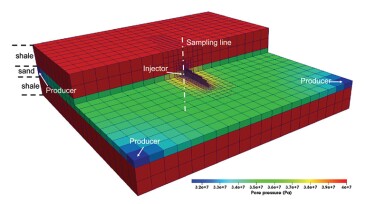
This paper introduces methods to fully couple reservoir simulation with wellbore flow models in fractured injection wells.
-
The paper presents a model for shale gas production in which CO2 is injected by huff ’n’ puff into a hydraulic fracture surrounded by a shale matrix.
-
This study explores pitfalls experienced when using capacitance/resistance modeling as a plug-and-play technique for waterflood optimization and discusses workarounds and mitigations to improve its reliability.
-
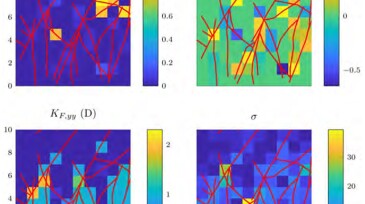
This paper analyzes several configurations of convolutional neural networks suited for predicting upscaled fracture permeabilities and shape factors required to close a dual porosity/dual permeability model.