Reservoir

Industry experts at URTeC assessed more than a decade of unconventional growth while discussing where productivity gains will come from next.
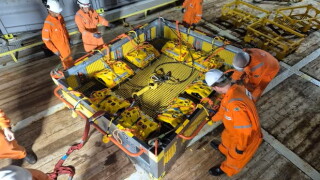
The technology has passed its first phase of qualification, with 84 nodes placed on the seafloor at a depth of 2,000 m to acquire 4D seismic data in the pre-salt Santos Basin.

Chevron and Halliburton describe how they built and deployed the fully autonomous closed-loop fracturing system that enables subsurface-driven optimization.
-
 Machine-learning methods have gained tremendous attention in the last decade. The underlying idea behind machine learning is that computers can identify patterns and learn from data with minimal human intervention. This is not very different from the notion of automatic history matching.
 -
A challenging problem of automated history-matching work flows is ensuring that, after applying updates to previous models, the resulting history-matched models remain consistent geologically.
-
This paper presents a work flow to match the history of reservoirs featuring complex fracture networks with a novel forward model.
-
Frac water disinfection experts become De Nora service arm in the unconventional oil and gas market.
-
Data volumes are growing at an exponential rate. How can high-performance computing solutions help operators manage these volumes? Will faster, stronger processors and cloud computing solutions be the answer?
-
This paper describes interpretation results of a 4D seismic-monitoring program in a challenging Middle East carbonate reservoir.
-
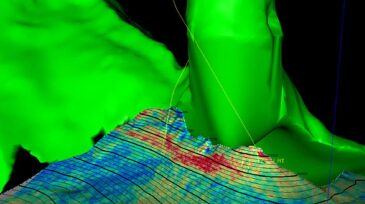
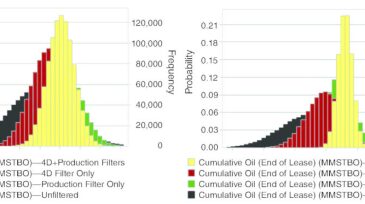
This paper outlines the value of 4D for reducing uncertainty in the range of history-matched models and improving the production forecast.
-
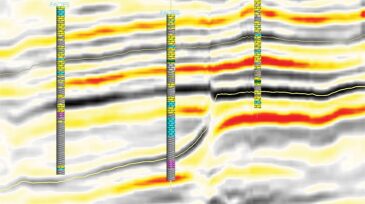
This paper discusses a project with the objective of leveraging prestack and poststack seismic data in order to reconstruct 3D images of thin, discontinuous, oil-filled packstone pay facies of the Upper and Lower Wolfcamp formation.
-
Last year saw continued contraction in the seismic data-acquisition industry. With this drop in acquisition business, fewer seismic data-acquisition papers were published. Nevertheless, three very good SPE papers covering important acquisition and processing topics are featured here.
-
Production growth in the Permian Basin requires drill rigs running at a high pace. That is challenging companies to push well productivity.