Reservoir

Industry experts at URTeC assessed more than a decade of unconventional growth while discussing where productivity gains will come from next.
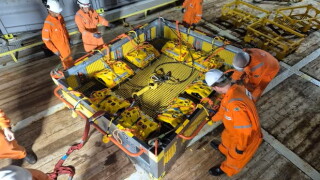
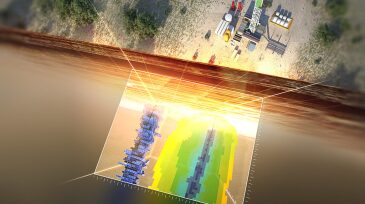
The technology has passed its first phase of qualification, with 84 nodes placed on the seafloor at a depth of 2,000 m to acquire 4D seismic data in the pre-salt Santos Basin.

Chevron and Halliburton describe how they built and deployed the fully autonomous closed-loop fracturing system that enables subsurface-driven optimization.
-
 SponsoredA Midland Basin case study on estimating production, drainage volume, and interference from multiple stacked wells.
 -
Total is expanding its development and use of artificial intelligence to bolster its exploration work, collaborating with Google Cloud—which is stepping up its presence in the oil and gas industry.
-
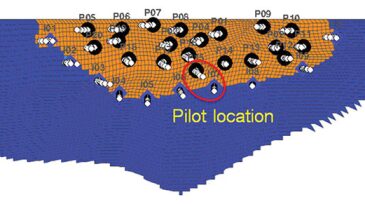
Production from an offshore Angola field has been decreasing because of subsea pressure declines amid water-cut increases and limited gas compressor capacity. The development process leading to the selection of high-boosting multiphase pumps is described.
-
Experimentation reveals that swellable nanogels increase their size faster than expected or produce aggregation leading to serious blocking problems at the sandface. This paper studies if the addition of a surfactant can help improve injectivity.
-
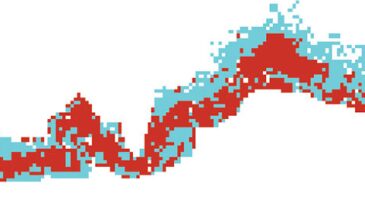
An ensemble-based 4D-seismic history-matching case is presented in the complete paper. Seismic data are reparameterized as distance to a 4D anomaly front and assimilated with production data.
-
In the complete paper, the authors propose a novel method to rapidly update the prediction S-curves given early production data without performing additional simulations or model updates after the data come in.
-
The aim of this work is to present the effectiveness of a fully integrated approach for ensemble-based history matching on a complex real-field application.
-
One unfortunate consequence of a base-case model, however, is the risk of an anchoring effect, in which case we may underestimate uncertainty. Essentially, the anchoring effect refers to our tendency to rely too heavily on the information offered, introducing a bias in the model-construction process
-
Big-data mining techniques can help determe the type-curves and the resulting estimated ultimate recovery of an asset being evaluated for acquisition.