Reservoir

Industry experts at URTeC assessed more than a decade of unconventional growth while discussing where productivity gains will come from next.
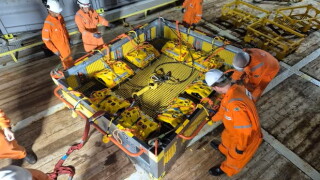
The technology has passed its first phase of qualification, with 84 nodes placed on the seafloor at a depth of 2,000 m to acquire 4D seismic data in the pre-salt Santos Basin.

Chevron and Halliburton describe how they built and deployed the fully autonomous closed-loop fracturing system that enables subsurface-driven optimization.
-
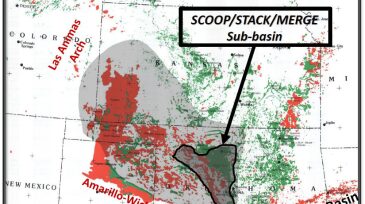
 Producers in Oklahoma’s newly opened Merge play are sitting atop a resource that rivals some major world gas fields and discoveries, Citizen Energy’s Geology CEO Greg Augsburger told the SPE Gulf Coast Section Business Development Group recently.
 -
Indy Chakrabarti, senior vice president of product management and strategy at Emerson Automation Solutions talks about developments in software solutions for the oil and gas industry.
-
Good diagnostic testing is often painstaking, time-consuming, and costly, but recent studies suggest that a lack of knowledge can be even costlier.
-
In the onshore world, one of the big advances for addressing increased sampling requirements has been to go to 24-hour shooting with continuous recording of simultaneously sweeping vibrators. This has been enabled by innovations in both acquisition and processing.
-
The appreciation of empirical realities permits the improvement of commercial depletion planning and enables a greater number of projects. This paper reviews the evidence for and against three doctrines in current use to develop depletion plans.
-
The feasibility test conducted offshore Abu Dhabi demonstrated the successful and safe deployment, seismic-data acquisition, and retrieval capabilities of the AMV and 3D sensor array.
-
Integrated surveillance is critical for understanding reservoir dynamics and improving field management. A key component of the surveillance is areal monitoring of subsurface changes by use of time-lapse geophysical surveys such as 4D seismic.
-
The complete paper proposes an azimuthal plane-wave-destruction (AzPWD) seismic-diffraction-imaging work flow to efficiently emphasize small-scale features associated with subsurface discontinuities such as faults, channel edges, and fracture swarms.
-
Scientists at Locus Bio-Energy Solutions have created a series of nontoxic microbial-based products that substantially increase oil production.
-
Despite an abundance of discovered resources, most companies are still running at unsustainable reserves replacement levels, necessitating further investment in exploration of conventional and unconventional reservoirs.