Reservoir

Canada’s development of large-scale digital drilling core libraries and open geoscience data platforms follows approaches pioneered in Australia, particularly Western Australia, through decades of government investment in geoscience data collection and preservation.

This study explores the carbon-capture and mineralization potential of ultramafic rock powders when exposed to flue gases generated from combustion of crude oil and mesquite-derived charcoal.

This paper documents the testing, integration, and field deployment of a metal expandable packer used as an openhole toe isolation plug in a deepwater well under high-pressure, high-temperature conditions.
-
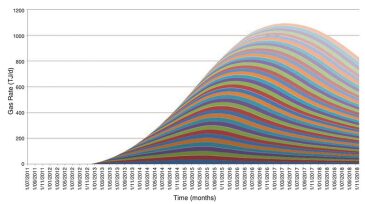
 Queensland, Australia, is currently host to a number of coal-seam-gas (CSG) to liquefied-natural-gas (LNG) projects under development.
 -
Surface jet pumps (SJPs) are simple, low-cost, passive devices that use a high-pressure (HP) fluid as the motive force to boost the pressure of produced-gas and -liquid phases.
-
The incredibly tight rocks that are the source of North America’s gas renaissance are off limits in Germany and France. Though Maersk drilled the first multifractured horizontal well in the North Sea in 1987, some European countries are now banning operations that have occurred legally for decades.
-
Drilling long horizontal wellbores and completing wells with multistage fracturing are common practices in shale-play development.
-
Polymer flooding has been used to enhance the production of oil from mature fields in Oman. This article discusses the trial of several approaches to improve the treatment of water produced from these fields.
-
The development of an economically efficient drilling program in shale-gas plays is a challenging task, requiring a large number of wells; even with many wells, the average well production and the variation of well performance (economics) remain highly uncertain.
-
Production of low-viscosity liquids, including condensates, from tight reservoirs such as shales is severely restricted by the ultralow permeability of such formations, limiting production to a very small fraction, usually less than 5%, of the liquids in place.
-
Matrix acidizing is commonly used as a preflush to the hydraulic-fracturing stimulation of shale formations. The process dissolves sediments and mud solids that inhibit the permeability of the rock, enlarging the natural pores of the reservoir and stimulating flow of hydrocarbons.
-
With the industry moving forward with exploration and development in the broader categories of unconventional resources globally, it is of paramount importance to assess and improve the different methods and tools for estimating reserves, to establish their accuracy and credibility.
-
There are no reliable estimates of technically recoverable resources (TRRs) for unconventional reservoirs outside North Amercia, and many countries lack the advanced technology such as horizontal drilling and hydraulic fracturing necessary to develop unconventional resources.