Reservoir
This study demonstrates how routinely acquired downhole temperature data allows for direct estimation of fluid saturations and delivers more accurate reservoir volume assessments, particularly in aquifer-supported systems.

Sponsored
Effective data analysis depends on seeing connections that matter. Explore how Spotfire enables a more intuitive approach to understanding petroleum data.

The deal adds over 1,000 potential drilling locations and almost doubles oil production for Houston-based Magnolia.
-
 A 44-well development tests what ConocoPhillips has learned about maximizing the value of the wells by figuring out how they drain the reservoir.
 -
The authors of this paper propose a hybrid approach that combines physics with data-driven approaches for efficient and accurate forecasting of the performance of unconventional wells under codevelopment.
-
Despite tens of thousands of potential candidates and the proven upsides, the unconventional industry has largely overlooked refracturing—possibly due to the way it’s discussed.
-
The physical characteristics of heavy oil and the formations in which it is found are often unique to a region or even to a specific asset, so recovery techniques must be tuned, adapted, and sometimes invented for each region. Creative professionals around the world are taking up this challenge and sharing their work with us in a wealth of excellent recent publication…
-
This paper describes a full-field and near-wellbore poromechanics coupling scheme used to model productivity-index degradation against time.
-
This paper develops a deep-learning work flow that can predict the changes in carbon dioxide mineralization over time and space in saline aquifers, offering a more-efficient approach compared with traditional physics-based simulations.
-
This paper explains how an operator’s projects in the Vaca Muerta have become more-efficient and cost-effective by increasing production and reducing well-delivery-cycle time while fostering the long-term sustainability of the project.
-
This year’s history matching and forecasting selections cover a deep-learning framework to forecast spatial/temporal dynamics of CO2 mineralization in reactive rocks, productivity decline analysis using coupled full-field and near-wellbore poromechanics modeling, and a reservoir graph network model for multiwell forecasting in unconventional reservoirs.
-
This paper describes the potential, challenges, and opportunities of using a modified steam-assisted gravity drainage configuration in the Mukhaizna heavy oil field in suboptimal operating conditions.
-
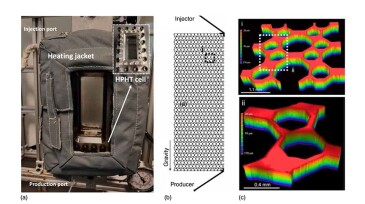
This study aims at understanding the effect of a surfactant known as a high-temperature emulsifying agent as an additive to the steam-assisted gravity drainage process and the possibility of forming oil-in-water emulsions.