Reservoir
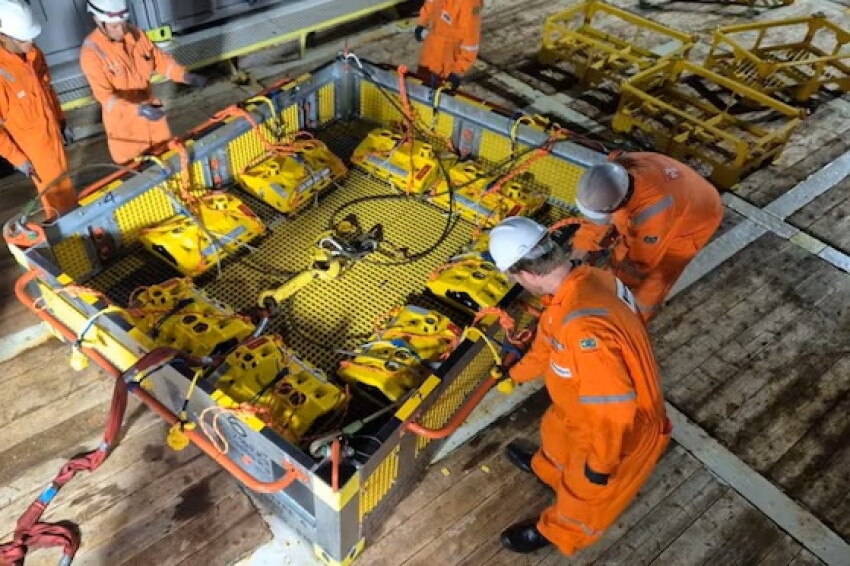
The technology has passed its first phase of qualification, with 84 nodes placed on the seafloor at a depth of 2,000 m to acquire 4D seismic data in the pre-salt Santos Basin.

Chevron and Halliburton describe how they built and deployed the fully autonomous closed-loop fracturing system that enables subsurface-driven optimization.

This article from the SPE Integrated Reservoir Management Technical Section (IRMTS) addresses decision timing across the reservoir cycle.
-
 This year’s titles have a good mix of new frontier exploration, expanding heartlands, and brownfield-development themes. Improved seismic survey techniques, seismic image uplift, enhanced seismic attribute analysis, reservoir characterization, fracture diagnostics, mitigation of induced seismicity, and carbon capture and storage topics also were featured.
 -
Rate transient analysis has been challenged in every sense of the word when it comes to tight reservoirs. An ongoing joint industry project aims to turn that around.
-
Carbon capture and storage, with the potential for usage, will be crucial if the world is to prevent global warming. While Norway has been injecting captured CO2 in saline aquifers since the mid-1990s, there has been no attempt, and no plans exist, in Europe to use CO2 for EOR. Why not?
-
The authors of this paper introduce a physics-based method for explicit pore-pressure prediction in naturally fractured shale petroleum reservoirs.
-
The authors of this paper aim to identify the effect of various geologic controls on hydrocarbon maturation in the Delaware Basin by restoring regional cross sections and performing simulations of organic-matter maturity.
-
This work applies an appropriate transient-test theory to demonstrate the applicability of each diagnostic plot along with clearly defining the characteristic features that allow each plot to be considered “diagnostic.”
-
In the life cycle of a field, from exploration and production to development, as we hone our knowledge to understand the reservoir, we often explore various subdomains of formation evaluation at various scales. In this issue, we explore three such subdomains at three different scales.
-
The authors of this paper describe an approach that combined active and passive near-field hydrophone measurements in a complex near-surface area offshore Abu Dhabi.
-
The goal of this paper is to improve the understanding of uncertainties affecting well performance and reservoir connectivity in an offshore Malaysian field.
-
The biggest sand haul ever reported by service provider Enercorp is a reminder that proppant flowback is a mounting challenge for shale producers.


![JPT_2023-02_GuestEd_Essential-Features-of-the-CO2-EOR-Process[1].jpg](https://assets.spe.org/dims4/default/c0ca44d/2147483647/strip/true/crop/879x491+0+18/resize/365x204!/quality/90/?url=http%3A%2F%2Fspe-brightspot.s3.us-east-2.amazonaws.com%2Fdf%2Fbd%2F1d2a3a144d61b40dbfee45355579%2Fjpt-2023-02-guested-essential-features-of-the-co2-eor-process1.jpg)