Reservoir

This study explores the carbon-capture and mineralization potential of ultramafic rock powders when exposed to flue gases generated from combustion of crude oil and mesquite-derived charcoal.

This paper documents the testing, integration, and field deployment of a metal expandable packer used as an openhole toe isolation plug in a deepwater well under high-pressure, high-temperature conditions.

Three papers are highlighted as the primary contributions because of their broad industry relevance. They focus on improving formation particle-size characterization, expanding the application of openhole gravel packs in depleted and compartmentalized reservoirs, and advancing the understanding of capillary pressure in sand production.
-
 In recent years, some effort has been made to use EOR techniques, particularly CO2 injection, to extract additional oil and gas from unconventional resources. This has the potential to change the dynamics (again) of oil production from these tight and difficult reservoirs.
 -
Operator Talos Energy now believes Zama’s gross recoverable resource lies in the upper half of its pre-appraisal estimate of 400–800 million BOE. The consortium is working toward a 2020 final investment decision on the project.
-
Merging tried-and-true physics-based models with data science is bolstering the Houston independent’s reservoir-engineering work on its deepwater and shale assets.
-
Ranking places US ahead of Saudi Arabia and Russia.
-
The combination will create one of the Haynesville Shale’s top gas producers, tripling Comstock’s Haynesville-Bossier acreage.
-
The evolution of hydraulic fracturing is a long and circuitous one that deserves examination. Engineering and completions leaders from Liberty Oilfield Services did just that, authoring a paper that encapsulates the high points in the development of the groundbreaking completions practice.
-
As the country pushes for higher output from its emerging unconventional sector, nature is pushing back. To get better results, operators there are increasing their reliance on technology.
-
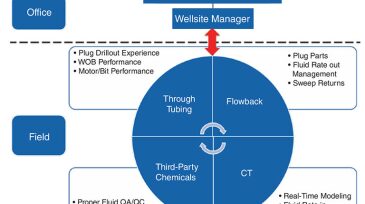
This paper presents a factory-model approach to improving CT drillout performance that has been used successfully for more than 3 years and has become standard practice.
-
This paper discusses the advantages of the in-line quench-and-temper (Q&T) process, which enhances overall CT life and reliability by producing tubing with more-uniform microstructure throughout its entire length, increased material strength, and improved bend-fatigue performance.
-
This paper presents a newly developed model to predict the breakdown pressures in cased and perforated wells.