Reservoir

This paper documents the testing, integration, and field deployment of a metal expandable packer used as an openhole toe isolation plug in a deepwater well under high-pressure, high-temperature conditions.

Three papers are highlighted as the primary contributions because of their broad industry relevance. They focus on improving formation particle-size characterization, expanding the application of openhole gravel packs in depleted and compartmentalized reservoirs, and advancing the understanding of capillary pressure in sand production.

This paper aims to establish a set of best practices for generating particle-size-distribution data from core samples.
-
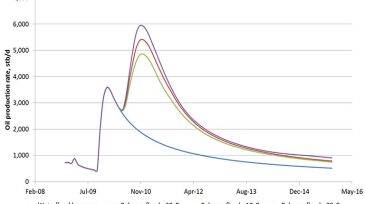
 This paper discusses an enhanced-oil-recovery (EOR) polymer-flood pilot at the Captain field in the UK North Sea during 2011–2013.
 -
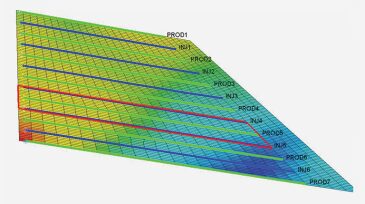
This paper discusses the operation of the largest offshore high-pressure water-alternating-gas (WAG) injection pilot using hydrocarbon (HC) gas, with a gas-injection capacity of approximately 100 MMscf/D, in the giant Al-Shaheen field offshore Qatar.
-
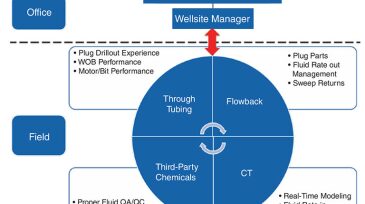
This paper presents a factory-model approach to improving CT drillout performance that has been used successfully for more than 3 years and has become standard practice.
-
This paper discusses the advantages of the in-line quench-and-temper (Q&T) process, which enhances overall CT life and reliability by producing tubing with more-uniform microstructure throughout its entire length, increased material strength, and improved bend-fatigue performance.
-
Wireline formation tests are a critical piece of the exploration and appraisal process, yet they come with a degree of uncertainty. The supermajor has tapped a new software developer to see if it can clear things up.
-
Indigo Natural Resources, Aethon Energy, and Rockcliff Energy are among the most active operators in the revived Haynesville Shale of North Louisiana and East Texas. And most people outside of the region likely have never heard of them.
-
This paper discusses how machine learning by use of multiple linear regression and a neural network was used to optimize completions and well designs in the Duvernay shale.
-
There is every reason to believe that enhanced oil recovery through huff-and-puff injections in US tight-oil plays could be a technical success across large numbers of wells. However, widespread economic success remains uncertain.
-
After a long cooling off period, this dry-gas shale play is once again red hot.
-
While some try to put the two enormous oil producers toe-to-toe, the best thing to do might be to understand why they are different.