Reservoir

Canada’s development of large-scale digital drilling core libraries and open geoscience data platforms follows approaches pioneered in Australia, particularly Western Australia, through decades of government investment in geoscience data collection and preservation.

This paper aims to establish a set of best practices for generating particle-size-distribution data from core samples.

This study explores the carbon-capture and mineralization potential of ultramafic rock powders when exposed to flue gases generated from combustion of crude oil and mesquite-derived charcoal.
-
 The incredibly tight rocks that are the source of North America’s gas renaissance are off limits in Germany and France. Though Maersk drilled the first multifractured horizontal well in the North Sea in 1987, some European countries are now banning operations that have occurred legally for decades.
 -
Drilling long horizontal wellbores and completing wells with multistage fracturing are common practices in shale-play development.
-
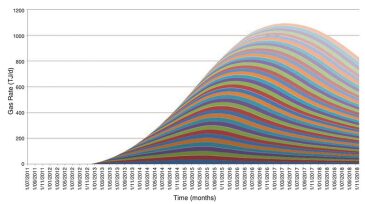
Queensland, Australia, is currently host to a number of coal-seam-gas (CSG) to liquefied-natural-gas (LNG) projects under development.
-
Surface jet pumps (SJPs) are simple, low-cost, passive devices that use a high-pressure (HP) fluid as the motive force to boost the pressure of produced-gas and -liquid phases.
-
Polymer flooding has been used to enhance the production of oil from mature fields in Oman. This article discusses the trial of several approaches to improve the treatment of water produced from these fields.
-
Hydraulically fracturing and stimulating multiple horizontal wells in sequence has been rapidly adopted by operators because of the potential for production without introducing unwanted risks.
-
At the Unconventional Resources Technology Conference in Denver, discussion revolved around solving problems below ground and above ground.
-
A major heavy oil producer in California has agreed to test a device that is designed to reduce emissions of smog-producing gases and increase the efficiency of gas burners.
-
With the industry moving forward with exploration and development in the broader categories of unconventional resources globally, it is of paramount importance to assess and improve the different methods and tools for estimating reserves, to establish their accuracy and credibility.
-
There are no reliable estimates of technically recoverable resources (TRRs) for unconventional reservoirs outside North Amercia, and many countries lack the advanced technology such as horizontal drilling and hydraulic fracturing necessary to develop unconventional resources.