Reservoir

Canada’s development of large-scale digital drilling core libraries and open geoscience data platforms follows approaches pioneered in Australia, particularly Western Australia, through decades of government investment in geoscience data collection and preservation.

This paper aims to establish a set of best practices for generating particle-size-distribution data from core samples.

This paper discusses the successful execution of two openhole gravel-pack completions in two Gulf of Mexico fields with depleted reservoirs.
-
 Hybrid steam/solvent processes have gained importance as a thermal-recovery process for heavy oils in recent years.
 -
An even temperature conformance along the length of the horizontal well is key in maximizing steam-assisted-gravity-drainage (SAGD) production rates.
-
Downhole instrumentation of the Khazzan tight gas appraisal wells provides a rare opportunity to quantify reservoir pressure and temperature dynamics.
-
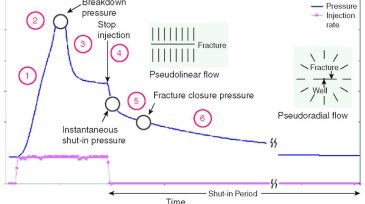
To achieve optimal production from unconventional reservoirs, it is useful to determine the permeability, pore pressure, and state of stress of rock strata.
-
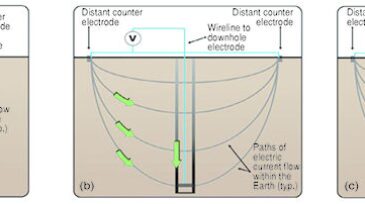
Add a new possible use for downhole casing: It can serve as broadcast antennae.
-
Polymer flooding in sensitive areas can require the transport of polymer fluids over long distances. Conventional wisdom limits transport distance or degradation occurs. This paper argues that critical velocity, not distance, is the controlling factor.
-
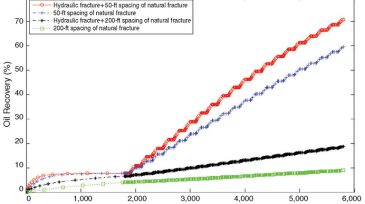
This paper focuses on the effects of injected-gas composition and fracture properties on oil recovery, concluding that cyclic gas injection in hydraulically fractured shale oil reservoirs is feasible for improving oil production substantially over primary production.
-
Initially, polymer flooding had not been considered as a viable enhanced-oil-recover (EOR) technology for Pelican Lake in northern Alberta, Canada, because of the high viscosity of the oil until it was considered in combination with horizontal wells.
-
This work presents a methodology to construct a sector model for the Tengiz field that covers one-sixth of the field area to evaluate improved-/enhanced-oil-recovery (IOR/EOR) processes to increase oil recovery through the life of the field.
-
Saudi Aramco’s plan to create a global network of research centers is becoming a reality. It recently celebrated the opening of its Houston center that the company’s President and Chief Executive Officer Khalid Al-Falih described as “an upstream research center like no other.”