Floating production systems

The new technology, recently highlighted at OTC, has received a statement of maturity from ABS.

Equinor said it found between 14 million and 24 million BOE with its most recent exploration well in the Polynya Tubåen prospect.

The project partners and the Newfoundland and Labrador government reach agreement over life-of-field benefits, royalties, and an equity option, moving development toward sanction in 2027.
-
 The long-term decommissioning of the historic Brent field has necessitated redevelopment of the younger Penguins field in the North Sea, where the UK hopes to see more revival projects in the coming years.
 -
Applying sufficient passive fire protection (PFP) on topside structural-steel members is critical. Simplified and conservative approaches are available to estimate the extent and amount of PFP necessary.
-
This paper describes a split-process FLNG design where primary production and gas-treatment functions are provided on a host platform while liquefaction occurs on a separate vessel.
-
Despite major advancements in deepwater projects in the Gulf of Mexico, FPSO usage has yet to increase.
-
As it has since 1969, the world came to OTC to make critical decisions, share ideas, and develop business partnerships to meet global energy demands.
-
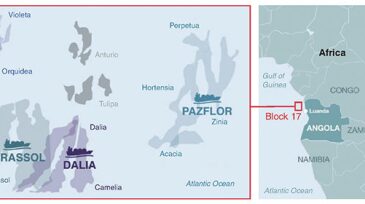
This paper describes the CLOV deepwater megaproject in Block 17 offshore Angola, which cost USD 8.4 billion to first oil.
-
Historically, the marine systems on a spar are relatively simple.
-
Construction costs, contractor involvement, flow assurance, and the integration of new technologies created to improve production are some of the deepwater challenges exacerbated by the current low price environment.
-
As many platforms begin to produce beyond their design life, maintenance of mooring systems becomes more critical. With redundancies in place, operators may be unaware of initial failures, which can have major consequences if another failure occurs.
-
A routine maintenance project became more complicated when an ROV inspection exposed unexpected trenching that reduced the holding capacity of the system.