Unconventional/complex reservoirs

This paper aims to establish a set of best practices for generating particle-size-distribution data from core samples.

This paper discusses the successful execution of two openhole gravel-pack completions in two Gulf of Mexico fields with depleted reservoirs.

By integrating experimental and mathematical modeling approaches, this work aims to advance the understanding of sand-detachment dynamics and formation instability under varying saturation conditions.
-
 Researchers at Yale University who analyzed groundwater wells in the Marcellus Shale area have determined that hydraulic fracturing is highly unlikely to be a direct source of contamination.
 -
This paper gives the recommended MSF horizontal-well spacing for several development scenarios in Saudi Arabian gas-reservoir environments.
-
Shale-gas resources were explored in Saudi Arabia by adopting a “technology-driven” approach against the US-based approach that might be termed the “factory” or “statistical” approach.
-
Although refracturing is a topic that has gained a lot of interest, many shale producers have been sitting on the sidelines because early results did not justify the spending
-
While the collapse in oil price is reshaping opinions about the North American shale revolution and the outlook for oil producers, natural gas producers in the United States are in a somewhat different position
-
A tight gas carbonate reservoir with no oil rim in a supergiant onshore gas field in Abu Dhabi was targeted for stimulation during a field review to increase field production.
-
To understand production from shale reservoirs, the role of hydraulically induced fractures, natural fractures, and their interaction in a formation must be captured.
-
Estimates of tight-reservoir hydrocarbon reserves continue to vary with uncertainty. What is known with certainty, though, is that current recovery rates are low and the upside is substantial.
-
The pursuit of sweet spots in unconventional oil and gas plays is driving the creation of an emerging set of data-driven systems to measure, map, and predict how wells will perform in unconventional reservoirs.
-
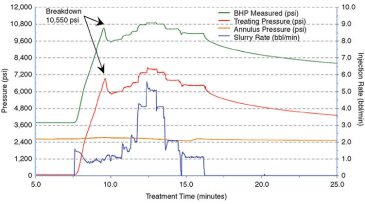
In hydraulic fracturing, the use of diagnostic-fracture-injection tests (DFITs) can provide valuable information.