Unconventional/complex reservoirs

This paper aims to establish a set of best practices for generating particle-size-distribution data from core samples.

This paper discusses the successful execution of two openhole gravel-pack completions in two Gulf of Mexico fields with depleted reservoirs.

By integrating experimental and mathematical modeling approaches, this work aims to advance the understanding of sand-detachment dynamics and formation instability under varying saturation conditions.
-
 This paper presents results from the analysis of the effect of in-fill drilling on parent-well performance, and describes a simplistic approach to understanding the effect of the quest for operational efficiencies and economic cycles on development strategies.
 -
In this study, detailed petrophysical and geological field models focusing on the middle and lower members of the Bakken Formation were developed.
-
For the past 2 decades, the use of DNA sequencing technology has largely been relegated to the domains of criminal forensics and the healthcare industry. One company is betting that the shale industry soon will join that list.
-
One of the biggest ways to lower the cost of production from shale would be to identify zones that are productive, or not, before fracturing them.
-
Approximately 5% of world annual gas production is being flared or vented. This is equivalent to approximately 110–140 billion m3 (Bcm) of gas, and equates to the combined gas consumption of Central and South America in 2013.
-
The importance of reducing emissions of methane, a short-lasting but powerful atmospheric greenhouse gas (GHG), received close attention from panelists at an IHS CERAWeek strategic dialogue, Tightening the Valves on Global Methane Emissions.
-
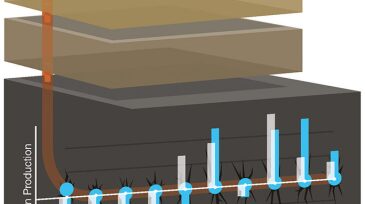
When it comes to hydraulic fracturing, steadiness may not be a virtue. That was the conclusion of a test to see if rapid pump rate variations would lead to greater production than conventionally fractured stages when the pressure was held steady.
-
With the world’s fifth-largest estimated shale gas reserves, there is great potential for Saudi Arabia to replicate North America’s unconventional growth.
-
A strategic objective of Saudi Aramco is exploring and developing deep and unconventional gas reservoirs, many of which are considered extremely tight.
-
On the far end of the flowback spectrum is a completion process called soakback. If the well has to be shut in until takeaway capacity is available, the completion fluids soak into the shale rock. Flowback analysis can help understand what happens in the formation.