AI/machine learning

Chevron and Halliburton describe how they built and deployed the fully autonomous closed-loop fracturing system that enables subsurface-driven optimization.
Aramco says it has saved $770 million over the past 3 years from the $70 million it has invested over the same period in corrosion management technologies.

The deal adds physics-based reservoir modeling and real-time decision workflows to SLB’s digital portfolio.
-
 Few oil and gas companies give data science projects the better part of a decade to prove out, but that’s just what this one did.
 -
The company has announced that it will be expanding the use of generative AI to assist its employees.
-
The oil and gas industry is embracing digital technology not just as a differentiator but as an enabler of innovation. The simple reality is that, if one doesn’t, they risk being out of the game.
-
AIQ, ADNOC, and SLB announced a new software suite that integrates artificial intelligence into reservoir analysis and field development projects.
-
Declining costs to launch monitoring satellites, as well as artificial intelligence, which makes parsing terabytes of emissions data feasible, have given the oil and gas industry an emerging tool for environmental stewardship.
-
The software that the duo is working on aims to optimize and automate the moving of drilling rigs.
-
The authors of this paper describe a procedure that enables fast reconstruction of the entire production data set with multiple missing sections in different variables.
-
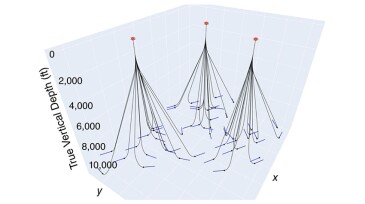
This paper presents an approach to optimize the location of wellhead towers using an algorithm based on multiple parameters related to well cost.
-
This paper presents a physics-assisted deep-learning model to facilitate transfer learning in unconventional reservoirs by integrating the complementary strengths of physics-based and data-driven predictive models.
-
We must admit that the oil field is still in the early days of its digital journey. It’s time to give serious thought to the expectation/reality gap, the cultural differences between the way we’ve always done things and the way that digital is changing us, and the pain points that may trip us up unless we’re careful.